
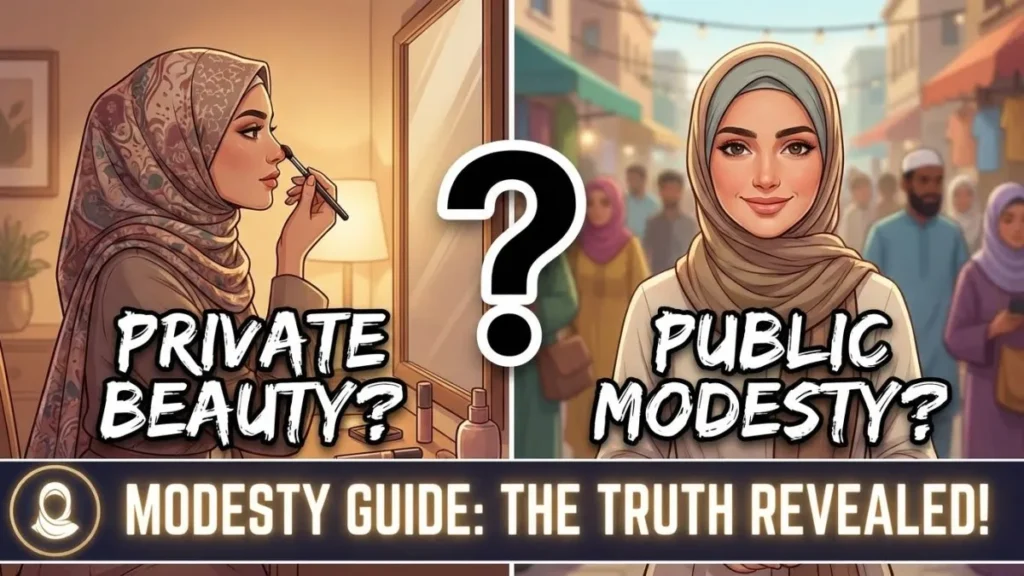
Let me explain something I’ve noticed many sisters get confused about. When Islamic scholars talk about makeup, they’re not talking about all cosmetics the same way.
Islam recognizes two types of adornment (zinah):
Apparent adornment (Zinah Zahirah) — These are cosmetics naturally shown without effort. Think kohl (kuhl) on your eyes, a ring on your hand, or henna on your palms. These appear when you’re living your normal life.
Hidden adornment (Zinah Batiha) — These are cosmetics applied specifically to beautify and attract attention. Think bright red lipstick, heavy blush, bold eyeshadow that makes you look “made-up,” or perfume worn intentionally to be noticed.
According to the Hanafi school of thought (which follows the Deoband tradition), the key rule is simple: you can show apparent adornment to non-mahram men only if there’s no fear of temptation and no intention to attract them.
The Prophet Muhammad (peace be upon him) was asked about this, and his guidance through the Companions shows that kohl and rings are specifically mentioned as permissible adornments that a woman may have visible.
Why Modesty Matters More Than Makeup
Before we go deeper, I want you to understand something important. Makeup isn’t the main issue in Islam — modesty is.
The Quran says to both men and women: “Lower your gaze and guard your modesty”. This isn’t about women alone. Both genders have a responsibility.
For women, modesty has three layers:
1) Your clothing — must cover your body, be loose and non-transparent, and not attract attention
2) Your behavior — how you speak, walk, and interact with non-mahram men should be respectful and dignified
3) Your appearance — this includes what you put on your face, what perfume you wear, and how you present yourself
I’ve seen many sisters focus too much on whether makeup is “haram” or “halal” and miss the bigger picture. The real question isn’t “Can I wear makeup?” It’s “Am I wearing it for the right reasons, and is it in line with the spirit of modesty?”
The Scholarly Consensus on Makeup and Cosmetics
Let me break down what different Islamic schools actually say, not what internet arguments claim.
The Hanafi School (Followed by Deoband)
According to the respected Hanafi scholar al-Sarakhsi, it is permissible to look at and have visible the area of apparent adornment of women, which includes the face and hands.
Specifically, these are permissible:
- Kohl (kuhl) on the eyes — explicitly mentioned as permitted adornment
- Rings on the hands — permissible jewelry
- Henna on palms and nails — allowed beautification
- Hair straightening products — permissible if they contain no impure ingredients
- General makeup — permissible if it doesn’t contain impure ingredients
- Colored contact lenses — permitted to beautify for your husband
- Nail polish — allowed (remove it before wudu)
However, all of this comes with one critical condition: there must be no fear of fitnah (temptation) and no intention to attract non-mahram men.
Al-Sarakhsi explained: “All of this is when looking is not with desire (shahwah). If one knows that if he looks, he will become desirous, then it is not permissible for him to look at any part of her because of the Prophet’s statement: ‘Whoever looks at the beauties of a foreign woman with desire, melted lead will be poured into his eyes on the Day of Resurrection'”.
What Is NOT Permissible
The same scholars explicitly prohibited:
- Plucking eyebrows — not allowed to reshape them by removing hair
- Imitation gold or silver rings — not permissible
- Platinum rings — not allowed for women
- Wearing perfume in public around non-mahram men — the Prophet discouraged this
Makeup Rules You Must Know: Step-by-Step Breakdown
Step 1: Check Your Intention
Before applying any makeup, ask yourself: Why am I wearing this?
Permissible intentions:
- To feel clean and neat when going to work or school
- To look presentable for routine tasks
- To feel confident about yourself in your own space
- To beautify yourself for your husband’s pleasure
- To maintain basic grooming standards (concealing blemishes that would be noticeable anyway)
Impermissible intentions:
- To attract the attention of non-mahram men
- To stand out and be noticed for your appearance
- To show off your beauty to others
- To imitate non-Muslim women’s makeup styles
- To appear “glamorous” or “made-up”
Real talk: If you’re putting on makeup to catch someone’s eye or make them notice you, that’s tabarruj (flaunting beauty), and Islamic scholars are clear that this is forbidden.
Step 2: Choose Minimal, Natural-Looking Cosmetics
I’ve studied what the classical Islamic scholars said about makeup, and here’s what they emphasized: the makeup should not make you look “made-up.”
This means:
✅ ACCEPTABLE:
- A light foundation to even out skin tone
- Concealer to hide blemishes
- Light, natural-looking blush
- Brown or black eyeliner (if applied subtly)
- Mascara in natural shades
- Neutral lipstick or lip balm
- Powder to reduce shine
❌ AVOID IN PUBLIC:
- Bright red or bold lipstick
- Heavy eyeshadow in dramatic colors
- Thick, dramatic eyeliner (cat-eye style)
- Bright blush that’s obviously makeup
- Contouring that transforms your face
- Anything that makes you look “glamorous” rather than neat
The key principle: If someone looking at you says “She’s wearing makeup,” then it’s probably too much for public.
Step 3: Consider Your Environment
Different contexts have different rules:
| Situation | What’s Appropriate | Why |
|---|---|---|
| Work/School with Mixed Gender | Minimal, neutral makeup; light concealer and mascara acceptable | You’re fulfilling responsibilities; excessive makeup could invite distraction |
| All-Female Gathering | Wear what you like; this is your mahram space | No non-mahram men present; beautify yourself freely |
| At Home with Husband | Beautify yourself as you wish | Encouraged to maintain attraction in marriage |
| Outside Running Errands | Basic grooming only; light makeup acceptable | Brief public presence; keep it minimal |
| Formal Muslim Event (Wedding, Lecture) | Modest, elegant makeup acceptable if it looks natural | Context of religious gathering emphasizes modesty |
| Outdoor Exercise or Hiking | No makeup needed; just wear sunscreen | Functionality matters more than appearance |
Step 4: Observe the Fitnah Test
Here’s what I tell sisters when they ask: Ask yourself honestly — does this makeup draw attention to me?
If you’re wearing mascara and kohl so dark that non-mahram men notice your eyes and find you attractive, that’s a problem.
If you’re wearing blush so bright that people see you and think about your appearance, reconsider it.
The fitnah test: Would this makeup cause a non-mahram man to look at me longer than necessary or think of me in an attraction way? If yes, it’s crossed the line.
This is why the classical Islamic scholars said that the condition of safety from temptation is very difficult to meet in modern times, especially for young women.
Read more: 7 Halal Gaming Rules: Is It Haram to Play Games with Magic or Gods? (Genshin & God of War)
Expert Tips and Best Practices
1. Reserve Your Best Makeup for Your Mahrams
I’ve noticed that many Muslim women struggle with this concept. You don’t have to give up makeup — just shift when and where you wear it.
Invest in good makeup and use it when you’re with your husband, family, or all-female friends. This is when you can enjoy full beautification without any Islamic concerns.
Pro Tip: Many Muslim women report feeling more confident in their marriages when they maintain their appearance at home. Your husband appreciates effort made for him, and it’s a form of respecting your relationship.
2. Kohl Is Your Best Friend
If you want to beautify your eyes in public, kohl (kuhl) is the safest choice because it’s specifically mentioned in Islamic texts as permissible adornment.
The Prophet Muhammad and his Companions used kohl, and it has health benefits (eye protection). Apply it subtly on the waterline rather than heavily, and it’s perfectly acceptable.
3. Master the “No-Makeup Makeup” Look
This is a technique where you use makeup but it looks natural. This is actually the Islamic ideal.
- Light, skin-toned foundation that blends invisibly
- Concealer only where needed
- Brown mascara instead of black (less dramatic)
- Cream blush applied lightly
- Nude or natural lipstick
The result? You look neat, healthy, and put-together — but not “made-up.” This respects modesty while allowing basic beautification.
4. Never Sacrifice Your Hijab Integrity
One thing I want to address: don’t uncover more of your face or hair to show off makeup.
Some sisters argue that if they’re wearing makeup, they should show it off by wearing the hijab loosely or showing more hair. This defeats the entire purpose of hijab.
If you’re wearing makeup, your hijab should be worn with the same commitment to modesty as always. The makeup is secondary; the hijab is primary.
5. For Western Contexts: Practical Balance
If you’re working or studying in a mixed-gender environment in a Western country, here’s what scholars have allowed:
- Light makeup is acceptable when you’re fulfilling professional or educational responsibilities
- The makeup should be minimal and natural-looking, not attracting attention
- Your overall demeanor should reflect modesty — speak softly, maintain distance, lower your gaze
- At social events, maintain the same standards as you would in Islamic environments
You’re not required to look “drab” or unkempt. You can be neat, clean, and well-groomed while being modest.
Common Mistakes to Avoid
Mistake #1: Thinking All Makeup Is Haram
This is incorrect. The scholars distinguish between types of makeup. Kohl, henna, rings, and natural-looking cosmetics are not forbidden — they’re actually part of Islamic tradition.
Don’t avoid all makeup out of misunderstanding.
Mistake #2: Wearing Makeup Only to Look Good for Others
If your intention is to attract non-mahram men or to show off, stop right there. That’s tabarruj, and it’s explicitly forbidden.
I’ve seen sisters wear beautiful makeup but with the wrong intention, and the Islamic scholars would not permit it. Check your heart.
Mistake #3: Confusing “Neat Appearance” with “Glamorous Appearance”
There’s a difference between:
- Neat: Skin is clean, you have light makeup, hair is covered properly
- Glamorous: You look like you’re ready for a photo shoot; people notice your beauty
One is modesty. One is showing off.
Mistake #4: Thinking “No One Will Know My Intention”
Actually, this is between you and Allah. God knows why you’re wearing makeup. You can’t hide your intention from Him, so make it pure from the start.
Mistake #5: Assuming Western Standards of Beauty Are Acceptable
In Western media, women are encouraged to wear heavy makeup to attract attention and stand out. This directly contradicts Islamic principles of modesty.
Don’t let Western beauty standards override your Islamic values. You can appreciate beauty without imitating non-Islamic beauty culture.
Real Examples: How to Apply This in Your Life
Example 1: Sarah Goes to Work
Sarah works in a corporate office with mixed genders. She wears:
- A tinted moisturizer with SPF
- Light concealer under eyes
- Subtle brown eyeliner
- Minimal mascara
- A nude lip balm
Result: She looks professional and neat. No one thinks she’s “made-up.” She’s not attracting unwanted attention. Her hijab is worn properly. This is acceptable.
Example 2: Fatima Goes to College
Fatima attends a mixed-gender university. She decides to:
- Wear full glam makeup with contoured face, dramatic eyeshadow, and bright lipstick
- Loosen her hijab to show more hair so people can see her makeup
- Wear tight clothing under her abaya
Result: She’s attracting attention. She’s displaying her beauty intentionally. Her hijab integrity is compromised. Islamic scholars would say this goes against modesty.
Example 3: Aisha at Home
Aisha puts on makeup at home:
- Full foundation
- Dramatic eyeshadow
- Winged eyeliner
- Bold lipstick
- She styles her hair beautifully
She does this for her husband, and he loves it. This is 100% encouraged in Islam. Marriage is a private relationship where beautification is a form of respect and love.
Example 4: Zainab at a Women’s Gathering
Zainab goes to a sisters’ event (all women). She wears makeup however she wants. This is completely fine because there are no non-mahram men present. Beautify yourself and enjoy!
FAQ: Your Questions Answered
Q1: Is it haram to wear makeup as a Muslim woman?
No, it’s not universally haram. However, the context and intention matter greatly. According to the Hanafi school (which Deoband follows), makeup that looks natural and doesn’t intend to attract non-mahram men is permissible. Heavy, obvious makeup that’s meant to beautify yourself for non-mahram men to see is forbidden.
Q2: Can I wear makeup at work if I’m around non-mahram men?
Yes, minimal, natural-looking makeup is acceptable at work, especially when you’re fulfilling professional responsibilities. However, it should:
Not be dramatic or noticeable
Not be applied with the intention to attract attention
Be paired with proper hijab and modest clothing
Not include heavy perfume
Q3: What about lipstick specifically? Can I wear it in public?
Q4: Is kohl allowed? I’ve heard different opinions.
Q5: My intention is just to feel confident. Is that okay?
It depends on how you define “confident.” If you mean feeling neat, clean, and presentable — yes, that’s fine. If you mean feeling attractive and noticing that non-mahram men are paying attention to you — that’s a problem.
Check your heart honestly: Are you wearing makeup to feel good about yourself internally, or to be perceived as beautiful by others?
Q6: Can I wear makeup for my husband?
Q7: What if I’m at a Muslim event or wedding?
Q8: Does Islam require me to look unattractive in public?
Not at all. Islam encourages cleanliness, neatness, and appropriate grooming. The difference is between:
Looking neat and well-groomed ✅
Looking glamorous and attention-seeking ❌
You can and should look nice. Just not in a way that’s designed to attract non-mahram men.
Q9: My family doesn’t wear hijab or makeup rules. What do I do?
Q10: Is it true that some scholars say all makeup is haram?
Some scholars, particularly those with stricter interpretations, do prohibit all makeup in public. However, this is not the majority opinion. The Hanafi, Maliki, and many Shafi’i scholars permit natural-looking, apparent adornment like kohl and rings. You should follow the school of thought that your local imam teaches or that makes sense to you, but know that permissibility is a valid Islamic position.
Final Conclusion: Modesty Over Makeup
Here’s what I want you to take away from this entire article: Makeup is not the main issue. Modesty is.
Islam allows women to be beautiful. The Prophet himself said, “Allah is Beautiful, and He loves beauty.” The scholars permitted kohl, henna, jewelry, and appropriate cosmetics.
But beauty in Islam is always balanced with modesty. You’re not trying to turn heads. You’re not trying to attract. You’re trying to present yourself with dignity and respect.
Here’s Your Action Plan:
1. Check your intention. Why are you wearing makeup? Be honest with yourself.
2. Keep it minimal in public. Light, natural-looking makeup is better than anything dramatic.
3. Save your best makeup for your mahrams. Wear it proudly at home with your husband.
4. Maintain your hijab properly. Don’t loosen it just to show off makeup.
5. Remember the spirit of hijab. It’s about directing attention to your character, not your appearance.
6. Follow scholarly opinion. Understand that Islamic schools permit natural-looking adornment when there’s no temptation and pure intention.
7. Be consistent. If you wear hijab, wear it properly. If you wear makeup, keep it modest.
The Prophet Muhammad (peace be upon him) taught that inner beauty matters more than outer beauty. But he also encouraged cleanliness and neatness. You can honor both.
You don’t have to choose between being a practicing Muslim and taking care of your appearance. You can do both — the Islamic way.