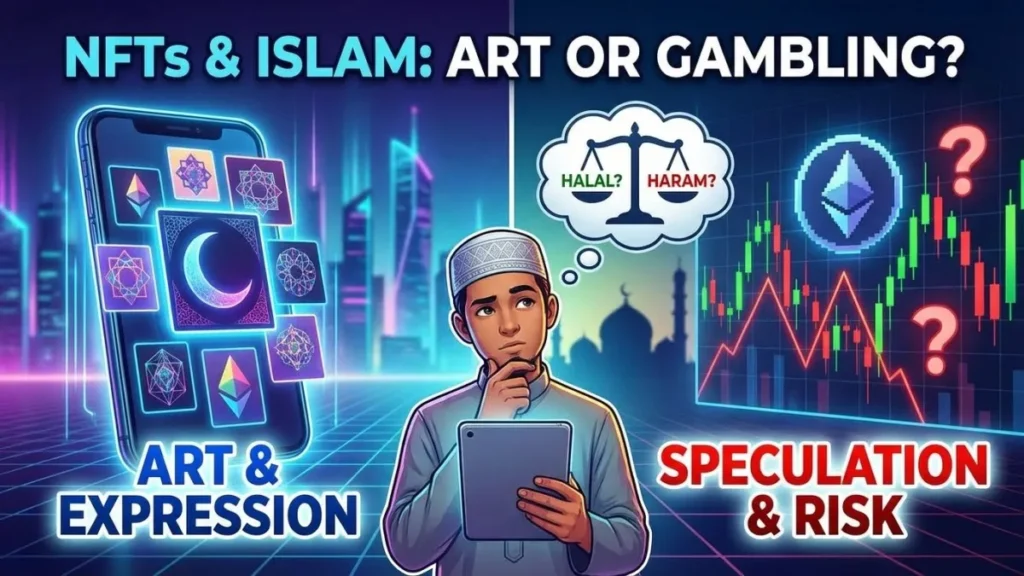
You’ve seen NFTs everywhere. Digital art selling for millions. Celebrities launching collections. Your friends talking about quick profits. But as a Muslim, you’re wondering: is this halal? Can I participate in this digital gold rush without compromising my faith? The answer isn’t as simple as yes or no—it depends entirely on how you approach NFTs. Let me break this down for you in the clearest way possible.
Key Takeaways
✅ NFTs as digital art ownership can be halal if the content is permissible and the transaction is clear
✅ Speculative NFT trading often contains haram elements like gharar (excessive uncertainty) and gambling
✅ The underlying asset matters – not all digital content is permissible to own or trade
✅ Intent and method determine permissibility – buying art differs from speculative flipping
✅ Scholars have varying opinions on NFTs, with no universal consensus yet
✅ Ethical alternatives exist for Muslims who want to engage with digital assets responsibly
What Are NFTs and Why Do Muslims Question Them?
Let me start with the basics because I’ve noticed many people jump into NFT discussions without understanding what they actually are.
NFT stands for Non-Fungible Token. In simple terms, it’s a digital certificate of ownership stored on a blockchain. Think of it like a deed to a house, but for digital items—art, music, videos, or even tweets.
Here’s what makes NFTs unique:
- Non-fungible means each one is unique and cannot be replaced with something identical (unlike a dollar bill)
- Blockchain-verified ownership that anyone can verify
- Transferable ownership that can be bought, sold, or traded
- Digital scarcity in a world where copying files is easy
Why Muslims Ask Questions About NFTs
I’ve spoken with dozens of Muslims confused about NFTs. Their concerns are valid and rooted in Islamic principles:
Gharar (Excessive Uncertainty): Many NFTs have unclear value propositions. You’re buying something intangible with highly speculative worth.
Gambling Elements: Some NFT projects function like lotteries—you buy random “mystery boxes” hoping for rare items.
Riba Concerns: When NFTs are used in DeFi (Decentralized Finance) lending protocols, interest-based transactions may occur.
Content Issues: Not all digital art is permissible. Some NFTs contain inappropriate imagery, music, or concepts.
Speculation vs. Investment: The line between legitimate investment and pure gambling can blur quickly.
The Islamic Framework for Evaluating NFTs
Before I tell you whether NFTs are halal or haram, you need to understand the framework scholars use. I’ve studied multiple fatawa (religious rulings) on this topic, and they all return to these core principles.
The Three Essential Criteria
1. The Asset Must Be Permissible (Halal)
The digital content itself must be allowed in Islam. This eliminates:
- Images or videos of nudity or lewdness
- Music that promotes haram activities
- Representations that mock religion
- Gambling-related content
- Alcohol or intoxication themes
Example: An NFT of beautiful calligraphy or landscape photography would generally be acceptable. An NFT of a casino scene or explicit content would not be.
2. The Transaction Must Be Clear (No Gharar)
You must know what you’re buying. The sale should involve:
- Clear description of the digital asset
- Transparent ownership rights
- Defined terms of the transaction
- Reasonable ability to determine value
Example: Buying an NFT where you can view the artwork, understand your rights, and know what you’re getting is clearer than buying a “mystery box” NFT where the content is revealed later.
3. The Intent Must Be Legitimate
Your purpose matters. Are you:
- Collecting digital art you appreciate?
- Supporting artists you value?
- Speculating for quick profits?
- Gambling on price increases?
I cannot stress this enough: intent transforms permissibility.
Read more: 7 Powerful Truths: Is Modeling Halal for Hijabis? Modesty vs Industry Standards
When NFT Trading Becomes Problematic
Let me be direct with you. Most NFT activity today falls into haram territory. Here’s why.
The Speculation Problem
I’ve watched the NFT market since 2021. The vast majority of buyers don’t care about the art. They care about “flipping” it for profit.
This creates gambling-like behavior:
- Buying based on hype, not value
- Hoping others will pay more (greater fool theory)
- No intrinsic value assessment
- Extreme price volatility
- FOMO-driven decisions
Deobandi scholars specifically warn against transactions where the primary goal is speculation on uncertain future prices. This resembles maisir (gambling).
Gharar in NFT Markets
Excessive uncertainty plagues many NFT projects:
Unclear ownership rights: Do you own the image file? The copyright? Just a blockchain entry?
Artificially inflated prices: Wash trading (selling to yourself) creates fake demand.
Rug pulls: Developers abandon projects after taking money.
Utility promises: Many NFTs promise future benefits that never materialize.
Sheikh Mufti Taqi Usmani has stated that transactions with high levels of uncertainty approaching gambling are not permissible, even if technically structured as sales.
The “Floor Price” Mentality
Here’s something I’ve observed: NFT communities obsess over “floor price”—the cheapest available NFT in a collection.
People buy purely hoping the floor rises. They don’t care about individual pieces. This is textbook speculation, not ownership of art.
The Hanafi school (followed by Deobandi scholars) requires actual benefit (manfaa) from purchased items. If your only goal is price appreciation with no personal benefit from the item itself, the transaction becomes questionable.
When NFTs Can Be Halal
Now for the good news. NFTs aren’t automatically haram. In certain circumstances, they can be permissible.
Legitimate Use Case #1: Digital Art Collection
If you genuinely appreciate digital art and want to own authenticated pieces, NFTs serve a legitimate purpose.
Requirements for permissibility:
- The artwork depicts halal content
- You’re buying for personal appreciation or collection
- The transaction is transparent
- You understand what rights you’re purchasing
- The price is reasonable relative to similar art
Real example: You commission a digital artist to create custom Islamic calligraphy. They deliver it as an NFT, giving you authenticated ownership. You display it on digital frames in your home. This is permissible.
Legitimate Use Case #2: Supporting Artists
I know Muslim artists who use NFTs to sell their work and earn a living. Buying their work to support them is valid.
The difference from speculation:
- You value the artist’s work
- You’re helping them earn halal income
- You may keep the NFT long-term
- Price appreciation is secondary to supporting the creator
This follows the Islamic principle of supporting lawful commerce and craftsmanship.
Legitimate Use Case #3: Functional NFTs
Some NFTs provide actual utility beyond just being collectibles:
- Event tickets as NFTs (verifiable, transferable)
- Membership passes to educational platforms
- Certificates for course completion
- Licenses for digital resources
If the NFT serves a clear functional purpose and isn’t primarily speculative, it’s more likely to be permissible.
The Deobandi Perspective on NFTs
You asked specifically about the Deobandi approach. Let me share what I’ve found from Darul Uloom Deoband and related scholars.
Core Deobandi Principles Applied to NFTs
The Deobandi school follows strict Hanafi jurisprudence. They apply these principles:
1. Physical vs. Non-Physical Assets
Classical Hanafi fiqh requires mal (wealth/property) to be something that can be possessed and has value. Scholars debate whether digital assets qualify.
Progressive view: Digital assets have recognized value in modern society and can be owned, similar to intellectual property.
Conservative view: True ownership requires physical possession; digital items are too intangible.
2. Bay’ al-Ma’dum (Sale of Non-Existent Items)
You cannot sell what doesn’t exist yet. Some NFT projects sell “future” NFTs or promise future utility. This is problematic.
Mufti Ebrahim Desai has ruled that selling items before they exist or are in your possession is generally not permissible in the Hanafi school.
3. Excessive Gharar
The Hanafi school is particularly strict about uncertainty. If an NFT’s value is almost entirely speculative with no tangible basis, it likely contains excessive gharar.
Fatawa on Digital Assets
While specific NFT fatawa are still emerging, Deobandi scholars have addressed related digital asset questions:
Digital goods can be valid sale items if they have recognized value and clear ownership.
Cryptocurrency trading is viewed skeptically due to speculation, but the underlying blockchain technology isn’t haram.
Speculative trading of any asset—digital or physical—without intention of ownership or use is discouraged.
Practical Guidelines for Muslims Considering NFTs
Let me give you a framework I developed after consulting various scholarly opinions. Use these questions before any NFT purchase.
The 7-Question Halal Test
Question 1: What am I actually buying?
Can you clearly explain what the NFT is? What rights come with it? If you can’t explain it simply, there’s too much gharar.
Question 2: Is the content itself halal?
Does the image, video, or audio contain anything impermissible? Be honest with yourself.
Question 3: Why am I buying this?
Is it for appreciation, collection, or utility? Or am I just hoping to sell it for more later? Your true intent matters.
Question 4: Can I afford to lose this money?
If losing the investment would harm you financially, you’re probably over-investing in something too speculative.
Question 5: Does the transaction involve any riba or gambling mechanics?
Are there interest-bearing loans involved? Random “minting” processes? Staking rewards that resemble interest?
Question 6: Is the project transparent?
Do you know who created it? Is there a real team? Or is it anonymous developers who could disappear?
Question 7: Would I want this if the price never increased?
This is the ultimate test. If your answer is no, you’re speculating, not collecting.
Red Flags to Avoid
I’ve seen these warning signs repeatedly in haram NFT projects:
🚩 “Get rich quick” marketing 🚩 Anonymous or fake team members 🚩 Promises of guaranteed returns 🚩 Pyramid or MLM-style structures 🚩 Inappropriate imagery or themes 🚩 “Mystery box” or random reveal mechanics 🚩 Extremely volatile prices with no underlying value 🚩 Artificial scarcity without real benefit
Common Mistakes Muslims Make With NFTs
I’ve counseled many Muslims who got involved with NFTs. Here are the mistakes I see repeatedly.
Mistake #1: Following the Hype
Your friends are buying NFTs. Social media is buzzing. You don’t want to miss out. So you buy without research.
Why it’s problematic: FOMO (Fear of Missing Out) is an emotional, not rational, decision. It often leads to gambling-like behavior.
What to do instead: Take time to research. If an opportunity requires instant action, it’s usually a red flag.
Mistake #2: Ignoring the Content
You see a potentially profitable NFT collection but ignore that the images contain inappropriate content.
Why it’s problematic: Even if the trading mechanism were halal, owning haram content is impermissible. You cannot profit from sin.
What to do instead: Always review the actual content. If you wouldn’t want it displayed in your home or shown to your family, don’t buy it.
Mistake #3: Treating It Like a Casino
I’ve seen Muslims check NFT prices dozens of times per day, buying and selling frantically, hoping for quick gains.
Why it’s problematic: This is gambling behavior, not investing. The emotional highs and lows mirror casino gambling.
What to do instead: If you buy an NFT, intend to hold it long-term for legitimate reasons. Set a plan and stick to it.
Mistake #4: Using DeFi With NFTs
Some platforms let you “stake” NFTs for rewards or borrow money against them.
Why it’s problematic: These mechanisms almost always involve riba (interest). You’re either earning interest or paying it.
What to do instead: Keep your NFT ownership simple. Buy, hold, or sell. Avoid complex financial products.
Mistake #5: Assuming All Scholarly Silence Means Permission
Some Muslims think: “My imam didn’t specifically say NFTs are haram, so they must be halal.”
Why it’s problematic: Scholars need time to study new technologies. Silence doesn’t equal permission.
What to do instead: Apply existing Islamic principles (avoiding gharar, gambling, riba) to new situations. When in doubt, consult knowledgeable scholars.
Alternatives for Muslims Interested in Digital Assets
You want to participate in the digital economy without compromising your faith. I respect that. Here are ethical alternatives.
Alternative #1: Islamic Digital Art Platforms
Some platforms specifically curate halal digital art:
- Muslim-run NFT marketplaces with content screening
- Islamic calligraphy collections
- Halal photography and nature scenes
- Educational content as NFTs
These focus on art and utility, not speculation.
Alternative #2: Direct Artist Support
Instead of buying NFTs on speculation markets:
- Commission digital artists directly
- Buy through artists’ personal websites
- Support Muslim creatives on ethical platforms
- Purchase with the intent to keep and appreciate
You get artwork you value without the speculation element.
Alternative #3: Traditional Digital Collectibles
Not everything needs to be on blockchain:
- Digital downloads of Islamic art
- E-books and courses
- Stock photography for personal use
- Software and tools that provide value
These give you digital ownership without the NFT speculation trap.
Alternative #4: Ethical Investing
If you’re drawn to NFTs for investment purposes, consider:
- Halal stocks through screened portfolios
- Sukuk (Islamic bonds)
- Real estate crowdfunding (halal-compliant)
- Small business investment
These provide growth potential without gambling elements.
Expert Tips for Ethical NFT Engagement
If you decide to engage with NFTs, here’s my advice after years of observing this space.
Pro Tip Box 💡
The 30-Day Rule: Before buying any NFT, save the money aside for 30 days. If after a month you still want that specific NFT for legitimate reasons (not just price speculation), then consider it. This eliminates emotional, FOMO-driven purchases that plague NFT markets. I’ve seen this simple rule save people thousands of dollars.
Tip #1: Start Extremely Small
Don’t invest significant amounts in NFTs. Start with tiny purchases to learn the technology and market without financial risk.
Think of your first NFT purchases as education expenses, not investments.
Tip #2: Focus on Muslim Artists
Support Muslim digital artists trying to earn halal income. This serves a legitimate purpose beyond speculation.
You’re helping someone’s lawful business while potentially acquiring art you value.
Tip #3: Verify Ownership Rights
Always research what rights you actually get:
- Do you own the copyright?
- Can you reproduce the image?
- Can you use it commercially?
- What are you actually buying beyond a blockchain entry?
Many people buy NFTs not realizing they own very limited rights to the actual artwork.
Tip #4: Avoid “Flipping” Mentality
If you buy an NFT planning to hold it less than a year, you’re probably speculating, not collecting.
Set a minimum holding period aligned with genuine appreciation, not short-term profit goals.
Tip #5: Consult Knowledgeable Scholars
The NFT space evolves rapidly. Consult scholars who understand both technology and fiqh.
General fatwas on “digital assets” may not address NFT-specific mechanics like smart contracts, royalties, and secondary markets.
Real Examples Explained Simply
Let me walk you through real scenarios so you can see how to apply these principles.
Example 1: The Profile Picture NFT
Scenario: A popular NFT collection sells cartoon profile pictures for $500 each. Prices sometimes reach $50,000. People buy hoping to resell at higher prices.
Islamic Analysis:
❌ Primary intent is speculation, not art appreciation ❌ Extreme price volatility with no intrinsic value basis
❌ Artificial scarcity (10,000 randomly generated images) ❌ Gambling-like behavior in buying and selling
Verdict: Highly problematic due to speculation and gharar. Most scholars would consider this impermissible.
Example 2: The Islamic Calligraphy NFT
Scenario: A Muslim calligrapher sells her artwork as NFTs for $50-200. She provides high-resolution files, prints, and certificates. Buyers are collectors of Islamic art.
Islamic Analysis:
✅ Clear, halal content (beautiful calligraphy) ✅ Transparent transaction with defined rights ✅ Reasonable pricing comparable to traditional art ✅ Legitimate purpose (supporting artist, collecting art) ✅ Functional benefit (can display the artwork)
Verdict: Permissible when purchased for legitimate collecting purposes, not speculation.
Example 3: The Gaming NFT
Scenario: A video game sells weapon and character NFTs. Players buy them to use in-game. Some players also trade them hoping to profit.
Islamic Analysis:
⚠️ Mixed situation requiring careful analysis: ✅ Functional utility within the game ❌ Speculative secondary market ⚠️ Game content must be reviewed (no haram elements) ⚠️ Intent matters (playing vs. speculating)
Verdict: If the game is halal and you’re buying for gameplay (not speculation), potentially permissible. Trading for profit makes it problematic.
Example 4: The Charity NFT
Scenario: An Islamic organization sells NFTs to raise funds. Proceeds go to building schools. NFTs are digital certificates of contribution.
Islamic Analysis:
✅ Charitable purpose ✅ Clear transaction (donation + commemorative certificate) ✅ Halal content ✅ No speculation intent (though secondary trading could occur)
Verdict: Generally permissible as a form of charity with a digital receipt. However, selling the NFT later for profit would need separate evaluation.
The Future of NFTs and Islamic Finance
Where is this heading? I’ve observed some positive developments.
Emerging Halal NFT Standards
Muslim technologists and scholars are working together to create:
- Shariah-compliant NFT platforms with content screening
- Transparent smart contracts that avoid riba mechanisms
- Educational resources about NFT fiqh
- Certification systems for halal digital assets
This is similar to how halal certification developed for food products.
Technology Isn’t the Problem
I want to be clear: blockchain technology and digital ownership aren’t inherently haram.
The problem is how they’re currently used—primarily for speculation and inappropriate content.
As the technology matures and Muslims create ethical applications, we may see genuinely beneficial uses.
Your Role in Shaping This Space
Every time you make an ethical choice in the digital economy, you vote with your wallet.
Support halal NFT initiatives. Reject speculation-driven projects. Encourage Muslim developers creating ethical alternatives.
We can help shape this technology toward beneficial uses rather than abandoning it entirely.
Frequently Asked Questions (FAQ)
Q1: Are all NFTs haram?
No, not all NFTs are automatically haram. The permissibility depends on three factors: the content of the NFT, the nature of the transaction, and your intent in purchasing.
An NFT containing halal content, purchased through a transparent transaction, for legitimate purposes (like collecting art or supporting an artist) can be permissible. However, most NFT activity today involves speculation and gharar, which are problematic.
The technology itself (blockchain, digital ownership) isn’t haram. It’s the current applications that often conflict with Islamic principles.
Q2: Is buying NFTs the same as gambling?
It can be, depending on how you approach it. If you’re buying NFTs hoping their price will increase without any genuine interest in the item itself, engaging in frequent buying and selling, and making decisions based on hype rather than value, then yes—the behavior closely resembles gambling.
However, if you’re purchasing digital art you genuinely appreciate, intending to keep it long-term, and the price is reasonable, it’s more similar to collecting traditional art.
The key difference is intent and behavior pattern. Ask yourself: would I want this NFT if I knew the price would never increase? If the answer is no, you’re probably gambling.
Q3: Can I buy NFTs if I only intend to hold them long-term?
Holding long-term is better than frequent trading, but it’s not the only factor. You must also consider:
Is the content halal?
Why are you buying it? (Genuine appreciation or just hoping for price increases?)
Is the transaction clear with minimal gharar?
Is the price reasonable relative to any intrinsic value?
Long-term holding doesn’t automatically make speculation permissible. If you’re buying purely on the hope that others will pay more years later (with no personal benefit from ownership), it remains problematic.
However, if you’re holding because you genuinely value the digital asset, use it, or appreciate it, then long-term ownership supports permissibility.
Q4: What about NFTs that provide utility like game access or membership?
NFTs with genuine utility are generally more permissible than purely collectible ones. If the NFT gives you access to halal games, educational platforms, events, or other real services, it’s functioning as a digital product or ticket.
However, verify:
The underlying service/game is halal
You’re buying for the utility, not speculation on resale value
The pricing is reasonable for what you receive
There are no riba-based mechanisms (like staking for interest)
Utility NFTs are closer to purchasing software licenses or event tickets, which are clearly permissible. The challenge is that many “utility” promises in NFT projects never materialize, creating gharar.
Q5: Is it permissible to create and sell NFTs as an artist?
Yes, if you’re a Muslim artist creating halal content, selling your work as NFTs can be permissible. You’re earning income through legitimate craftsmanship.
Guidelines for permissibility:
Create only halal content (no inappropriate imagery, music promoting haram, etc.)
Be transparent about what buyers receive (rights, access, etc.)
Price your work reasonably
Don’t artificially create scarcity to manipulate prices
Avoid mechanisms that resemble gambling (mystery reveals, loot boxes)
Selling your art is different from the speculation that buyers might engage in later. You control your part of the transaction. Focus on creating value and serving customers honestly.
Q6: What if I already own NFTs? Do I need to sell them immediately?
If you already own NFTs, evaluate each one using the criteria I’ve discussed:
Assess the content: If the NFT contains haram content, you should dispose of it. You can sell it (better someone else has it than destroying value) or simply abandon the wallet.
Assess your intent: If you bought it purely for speculation, consider whether continuing to hold it is wise. You’re not obligated to sell at a loss, but future purchases should follow better criteria.
Assess the situation: If it’s a legitimate digital art piece you appreciate, there’s likely no issue keeping it.
Don’t panic. Seek knowledge, evaluate your situation, and make informed decisions going forward. Past mistakes with lesser knowledge are forgivable. It’s your future choices that matter most.
Q7: Do all Islamic scholars agree on NFTs?
No, there’s no universal consensus yet. NFTs are too new for widespread scholarly agreement. You’ll find:
Conservative scholars: View most NFT activity as speculative gambling and advise complete avoidance.
Moderate scholars: Recognize potential permissible uses (legitimate digital art) but warn against speculation.
Tech-savvy scholars: Are developing frameworks for halal NFT engagement while acknowledging current market problems.
The Deobandi tradition tends toward the conservative end, emphasizing caution with new financial instruments. Other schools may have different approaches.
When scholars disagree, it’s best to take the safer route if you’re unsure. Avoiding doubtful matters protects your faith and finances.
Q8: Are cryptocurrency and NFTs the same in Islamic ruling?
No, they’re related but different. Cryptocurrency is a digital currency, while NFTs are digital assets claiming uniqueness.
Cryptocurrency issues:
Extreme volatility
No intrinsic value (for many coins)
Speculation-driven
Some scholars question whether they qualify as valid currency
NFT-specific issues:
The content of the asset matters
Ownership rights are often unclear
Speculation is even more extreme
Many NFTs have no functional value
Some scholars are more lenient toward certain cryptocurrencies (especially those with stable value or utility) while being stricter on NFTs. Others view both skeptically.
Each requires separate analysis, though both face scrutiny for speculation and gharar.
Q9: What should I do if my friends pressure me to invest in NFTs?
Stand firm in your values. Real friends respect your faith-based boundaries.
You can say:
“I’m being cautious with speculative investments.” “I’m not comfortable with the uncertainty involved.” “I’m focusing on investments I better understand.”
You don’t owe anyone a detailed religious explanation if you’re not comfortable giving one.
Remember: Many people lose money in NFTs. Your caution might save you from financial harm while also protecting your faith. That’s wisdom, not weakness.
If friends mock your principles, reconsider the friendship. Good companionship supports your growth, not your downfall.
Q10: Where can I learn more about Islamic perspectives on digital assets?
For reliable Islamic guidance on NFTs and digital assets:
Scholarly sources:
Darul Uloom Deoband (deoband.org) – For Hanafi/Deobandi perspectives
Islamweb.net – For comparative fiqh perspectives
Mufti Menk and other contemporary scholars who address modern finance
Educational platforms:
Islamic Finance Guru – Modern Islamic finance topics
Islamicfinance.com – Academic resources
Local imams and scholars familiar with technology
Communities:
Muslim tech and finance forums
Halal investment groups
Your local Islamic center
Always verify information with qualified scholars. Not every “Islamic finance expert” online has proper training. Seek those with both traditional Islamic education and understanding of modern technology.
Final Conclusion and Actionable Steps
Let me be completely honest with you. After researching NFTs extensively and consulting Islamic principles, most NFT activity today is problematic for Muslims.
The market is driven by speculation, contains significant gharar, and functions more like a casino than an art marketplace. The vast majority of people buying NFTs are gambling, not collecting.
However, this doesn’t mean NFTs are inherently haram. Digital ownership technology has potential legitimate uses. The problem is how it’s currently applied.
Your Action Plan
Here’s what I recommend you do right now:
Step 1: Avoid the Hype
Don’t buy NFTs just because everyone else is. FOMO is not a valid reason for investment. Take a breath and step back.
Step 2: Evaluate Your Intent
Ask yourself honestly: Why am I interested in NFTs? If the answer is “to make quick money,” that’s a red flag. If it’s “to own digital art I love,” that’s better.
Step 3: Apply the 7-Question Test
Go back to the seven questions I provided. Any NFT you consider must pass all seven. Don’t make exceptions for yourself.
Step 4: Prioritize Traditional Halal Investments
Focus your wealth-building on clearly permissible investments: halal stocks, real estate, businesses, and sukuk. These have track records and clearer Islamic rulings.
Step 5: Support Muslim Digital Artists
If you want to engage with digital art, find Muslim creators producing halal content. Support them directly through ethical means.
Step 6: Educate Others
Share what you’ve learned with Muslim friends who might be considering NFTs. Help them avoid financial and spiritual harm.
Step 7: Consult Before Acting
If you’re seriously considering an NFT purchase, consult a knowledgeable scholar first. Get specific guidance for your situation.
My Final Advice to You
I’ve seen too many Muslims get caught up in NFT speculation, lose money, and later regret it. The promises of quick wealth are intoxicating, but they rarely materialize.
Your wealth is a trust from Allah. Guard it carefully. Invest it wisely. Don’t gamble with it in speculative markets, whether physical or digital.
If something feels uncertain, uncomfortable, or too good to be true, it probably is. Your instincts about doubtful matters are often right.
The safest path is often the best path. You won’t regret avoiding NFTs. You might deeply regret getting involved.
Focus on building wealth through clear, halal means. Support ethical digital innovation when it emerges. But don’t feel pressured to participate in every new trend.