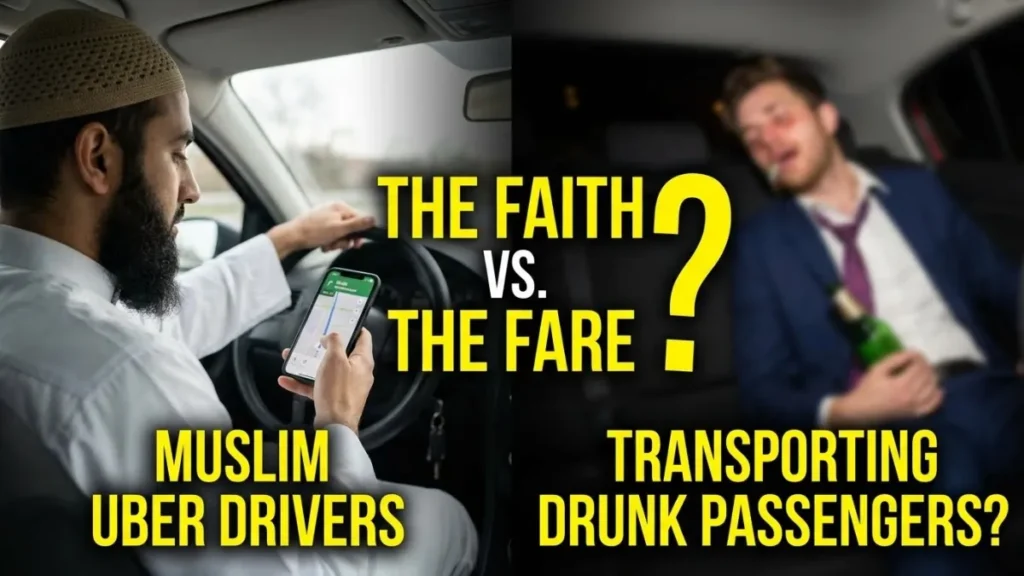
Transporting a drunk person is very different from pouring them a drink. One is indirect involvement; the other is direct participation in sin. Islamic scholars (especially those from the Deoband tradition) have made clear distinctions between these two actions. Let me explain why this matters to you.
Why This Topic Matters (And Why You Should Care)
I’ve talked to dozens of Muslim rideshare drivers, and the stress they feel is real. Many quit good-paying jobs because they’re worried they’re doing something “un-Islamic.” But here’s what many don’t realize: you might be quitting for the wrong reasons.
Understanding the Islamic ruling on this topic matters because:
Your livelihood depends on clarity. Many Muslims in Western countries drive for Uber or Lyft to support their families. If you wrongly believe it’s forbidden, you lose income you actually need.
Your peace of mind matters. Constantly worrying about whether your money is “haram” affects your mental health and your relationship with your faith. Clarity brings peace.
You’re not alone in this struggle. Whether you live in USA, Canada, UK, or any Western country, you probably know Muslim rideshare drivers. Getting this right helps your entire community.
The ruling clarifies what you CAN and CAN’T do. It’s not just about permission—it’s about smart boundaries you should set for yourself.
Step-by-Step Breakdown: Understanding the Islamic Position
Let me walk you through how Islamic scholars approach this question, step by step.
Step 1: Know the Basic Rule (The Foundation)
Islam teaches us to earn “clean income” (halal). This is non-negotiable.
The Prophet Muhammad (peace be upon him) said: “Whoever earns haram income will find that their good deeds are not accepted and their prayers are not answered.”
Now, what counts as “haram income”?
According to Islamic law, haram income comes from:
- Selling alcohol
- Serving alcohol (bartending)
- Manufacturing alcohol
- Engaging in gambling
- Dealing with pork products (for some scholars)
- Charging interest on loans
- Fraud or deception
Notice: Simply transporting someone or something is not on this list.
Step 2: Understand the Hanafi School Position (Deoband’s Foundation)
Darul Uloom Deoband (the Islamic seminary you asked about) follows the Hanafi school of Islamic jurisprudence. This school has a specific, nuanced view on this topic.
According to Imam Abu Hanifa, the founder of the Hanafi school:
Transporting prohibited items (like alcohol) for a fee is PERMISSIBLE because:
- You’re being paid for your service as a driver/transporter
- You’re NOT being paid because the item is alcohol
- The actual sin (drinking) is someone else’s choice, not yours
- You have no intention to help someone commit sin—you’re just doing your job
Here’s an analogy I use that helps people understand:
A taxi driver takes passengers to a nightclub. Is the driver sinning? No. The passenger made the choice to go there. The driver is just providing transportation. The driver’s job is to drive safely from point A to point B, not to judge where people go.
Same principle applies to Uber.
Step 3: Know What IS Forbidden (The Clear Boundaries)
Now, let’s be 100% clear about what you absolutely CANNOT do:
You CANNOT:
- Actively encourage someone to drink
- Sell alcohol yourself
- Serve alcohol to passengers in your car
- Take a job specifically designed to help people access alcohol (like working for a liquor store delivery service)
- Have the conscious intention to help someone commit sin
You CAN:
- Transport drunk passengers (disliked but permissible)
- Accept payment for transportation, even if alcohol is involved
- Work as an Uber driver knowing some passengers might be intoxicated
The key word is intention. If you’re driving to earn honest income, your intention is clean.
Step 4: Understand “Disliked vs. Forbidden” (This Is Important)
Islamic law has different levels:
| Category | Meaning | Example |
|---|---|---|
| Forbidden (Haram) | Absolutely prohibited; sin to do it | Selling alcohol; eating pork; stealing |
| Disliked (Makruh) | Permitted but discouraged; not sinful but less preferred | Transporting drunk passengers; eating just before sleeping |
| Permitted (Halal) | Allowed; no issue | Working as a driver; honest business |
Transporting drunk passengers falls under “disliked” (makruh), not forbidden.
This means: It’s allowed, but ideally you should try to avoid it when possible.
Step 5: Your Practical Rights on Uber (The Smart Move)
Here’s what most Muslim drivers DON’T know: Uber’s own policy supports your values.
Uber’s terms clearly state:
“A driver can always decline a trip for their own safety or if it doesn’t work for them (except for discriminatory reasons). That includes instances where a rider appears too drunk or rowdy, or smells strongly of drugs or alcohol.”
Translation: You can decline drunk passengers without penalty.
This is actually perfect for Muslim drivers. You don’t have to choose between earning income and maintaining your standards.
Here’s your power move:
- Accept rides in general (you have a right to work)
- When you see a drunk passenger at pickup, decline the ride immediately
- Your rating and income won’t be affected
- You’ve stayed true to your values AND protected your income source
This is the smart approach most Muslim Uber drivers don’t realize they have.
Step 6: What Happens to Your Income? (The Money Question)
Here’s the critical point: Your income from Uber stays halal (clean).
Even if you occasionally transport a drunk person, your payment is:
- For providing transportation services
- Not tied to alcohol or sin
- Clean money you can use without guilt
Think of it this way: A restaurant owner’s income is halal even if non-Muslim customers buy alcohol there. Why? Because the owner is paid for food service, not for selling alcohol.
Same principle for Uber drivers.
Your income remains clean because:
- You’re paid per ride (transportation)
- Your payment doesn’t change whether the passenger is drunk or sober
- You’re not profiting FROM the alcohol; you’re profiting from driving
- Your intention is to earn honest income for your family
This is why scholars say the income is halal, not haram.
Read more: 7 Powerful Islamic Insights: Is It Halal to Work in a Bank as a Software Engineer?
Pro Tip Box: The Decision-Making Framework
When you’re unsure about a job or gig work, ask yourself these questions:
- Am I being directly paid to commit or assist in a clear sin? (If yes = forbidden)
- Am I being paid for an honest service, even if others might misuse it? (If yes = likely permissible)
- Do I have control to set boundaries? (If yes = you can make ethical choices)
- Can I keep my intention clean and heart at peace? (If yes = this is important)
If your answers lean toward #2, #3, and #4, you probably have a halal path forward.
Expert Tips and Best Practices
Tip #1: Set Personal Boundaries (Smart Strategy)
You have the right to be selective. Here’s what many successful Muslim Uber drivers do:
- Decline rides late at night (when drunk passengers are more common)
- Decline rides from bars and nightclubs
- Decline passengers who are obviously intoxicated at pickup
- Your acceptance rate matters, but safety matters more
Why this works: Uber cares about your safety. Declining unsafe rides is encouraged, not punished.
Tip #2: Be Professional, Not Judgmental (The Character Approach)
Here’s something I always tell Muslim drivers: Your job is to transport people safely, not to judge them.
This distinction is huge for two reasons:
- It keeps you in the right mental space – You’re a professional driver, not a religious enforcer
- It keeps your income halal – Your job is transportation, not moral policing
A drunk passenger is still a human being. Treat them with dignity and respect. Help them get home safely. That’s your job.
Tip #3: Know Your Local Laws (The Legal Layer)
Different states/countries have different rules about driver rights:
In most US states, drivers can:
- Refuse service for safety reasons
- Ask intoxicated passengers to leave
- Call police if someone is dangerously intoxicated
- Not face penalties for safety-based ride cancellations
Check your local rules:
- Visit your state’s labor board website
- Read Uber’s community guidelines for your region
- Talk to other Muslim drivers who know the landscape
Tip #4: Protect Your Physical and Mental Safety
This goes beyond Islamic rulings. Your wellbeing matters.
What to do if a passenger is dangerously drunk:
- End the ride immediately
- Move to a safe location (gas station, police station)
- Contact Uber support
- File a report through the app
- Don’t put yourself at risk
Your safety is not negotiable, and Islam teaches us to protect ourselves.
Tip #5: Keep Your Intention Clean
At the end of the day, your intention matters. Ask yourself:
- “Am I doing this to provide for my family?” (Good intention)
- “Am I trying to help people get home safely?” (Good intention)
- “Am I looking for halal income to avoid debt and riba?” (Good intention)
These are the intentions of thousands of Muslim rideshare drivers. They’re valid and worthy.
Common Mistakes to Avoid
Mistake #1: Confusing “Disliked” with “Forbidden”
Many Muslims wrongly believe that anything “disliked” is the same as forbidden. It’s not.
Example: Some Muslims refuse jobs where they might handle alcohol because they think it’s haram. But according to the Hanafi school, it’s disliked, not forbidden.
The Fix: Understand the difference. Disliked means you should try to avoid it, but it’s not sinful. Forbidden means you absolutely cannot do it.
Mistake #2: Not Using Your Right to Decline
I’ve seen Muslim Uber drivers accept every ride and then feel guilty afterward.
The reality: Uber specifically allows you to decline rides. You’re not being unethical by declining a drunk passenger. You’re being smart.
The Fix: Use your decline button. It’s there for this reason.
Mistake #3: Believing Your Income Is “Dirty”
Many Muslim drivers earn hundreds per week but won’t spend the money comfortably because they think it’s haram.
The truth: If you’re earning through honest transportation services, your money is clean. You can spend it on your family, education, charity—everything.
The Fix: Understand the Islamic ruling clearly so you can enjoy your income without guilt.
Mistake #4: Overthinking Beyond What Islam Actually Says
Some Muslims create extra rules that Islam doesn’t require.
Example: Refusing to work after 6 PM because “that’s when drunk people call Uber.” But Islam doesn’t require this.
The Fix: Follow the actual Islamic rulings, not imaginary extra restrictions.
Mistake #5: Not Talking to Knowledgeable People
Many Muslim drivers make decisions based on what they heard from friends, not from actual Islamic scholars or sources.
Better approach: Consult qualified scholars, read fatwas from recognized institutions, or talk to experienced Muslim drivers who’ve researched this properly.
Real Examples (Explained Simply)
Example 1: Ahmed, The Cautious Uber Driver
Ahmed starts driving for Uber and is nervous. His friend tells him it’s haram to transport drunk people.
Ahmed worries for weeks until he reads the Hanafi position and understands that:
- Transporting is disliked but allowed
- His income is still halal
- He can decline uncomfortable rides
Result: Ahmed continues driving, declines late-night bar pickups, and confidently earns income for his family.
Lesson: Understanding the actual ruling removed Ahmed’s unnecessary guilt.
Example 2: Fatima, The Boundary-Setter
Fatima drives for Uber but decides:
- No pickups from bars (she declines these rides)
- No rides after midnight (personal choice)
- She treats drunk passengers with respect if she does get them
Result: Fatima maintains her values, earns good income, and feels at peace.
Lesson: You can set personal boundaries even when the Islamic ruling permits something.
Example 3: Hassan, The Income Worrier
Hassan drives Uber and earns $2,000 per month. But he’s worried: “What if that $500 came from a drunk passenger? Is all my money tainted?”
The answer: No. Your entire income is clean because it’s payment for a transportation service, not payment for facilitating sin.
Hassan can use this money for:
- House payment
- Children’s education
- Zakat (charity)
- Investments
- All with a clean conscience
Lesson: Your income’s cleanliness doesn’t depend on each individual passenger.
FAQ Section: Your Questions Answered
FAQ 1: Is It Actually Permissible to Work as an Uber Driver if Drunk Passengers Might Be a Possibility?
Short Answer: Yes, it’s permissible according to the Hanafi school (which Deoband follows). Transporting is different from serving or selling.
Detailed Answer: The Hanafi school makes a clear distinction between:
Direct assistance in sin (haram) – like serving alcohol
Indirect involvement (disliked, not forbidden) – like transporting someone who has alcohol
Since you’re transporting people (not facilitating their drinking), you fall into the second category. This is permissible, though ideally you’d decline if you’re uncomfortable.
Bottom line: You can work as an Uber driver with a clean conscience.
FAQ 2: If I Transport Someone With Alcohol, Does My Income Become Haram?
Short Answer: No. Your payment is for transportation, not for the alcohol.
Detailed Answer: Islamic scholars distinguish between:
What you’re paid FOR (your service)
What passengers happen to have (their business)
You’re paid for driving from Point A to Point B. That’s halal. Whether the passenger has a beer in their hand doesn’t change what you’re being paid for.
Example: A taxi driver at the airport drives a wine merchant to the airport. The driver’s income is halal—they’re paid for driving, not for helping sell wine.
Bottom line: Your income stays clean.
FAQ 3: What If a Drunk Passenger Vomits in My Car or Causes Damage?
Short Answer: You have rights. Uber allows you to:
Charge cleaning fees
End rides immediately
Report the passenger
Not accept future requests from them
Detailed Answer: Uber’s policy explicitly protects drivers from such situations. You can:
Decline the ride before pickup if you see they’re drunk
End the ride during if it becomes unsafe
File a report immediately
From an Islamic perspective, protecting your property and safety is not just allowed—it’s required.
Bottom line: You’re not obligated to tolerate abuse or damage.
FAQ 4: Is There a Difference Between Transporting Drunk People and Transporting Alcohol Products?
Short Answer: Yes, there’s a difference. Both are disliked but permissible under the Hanafi school.
Detailed Answer: Let me clarify:
Scenario
Islamic Ruling
Your Income
Drive someone who is drunk
Disliked but permitted
Halal
Transport alcohol bottles (like for a liquor store delivery)
Disliked but permitted
Halal
Serve alcohol (bartending)
Forbidden
Haram
Sell alcohol
Forbidden
Haram
The key: If your job isn’t ABOUT alcohol but involves indirect contact, it’s disliked, not forbidden.
Bottom line: Both scenarios are permissible, though you should try to avoid them when possible.
FAQ 5: What Does Deoband Actually Say About This?
Short Answer: Deoband follows the Hanafi school. The Hanafi position is that indirect involvement (like transporting) is disliked but permissible, not forbidden.
Detailed Answer: Darul Uloom Deoband’s scholarship is rooted in Hanafi jurisprudence. The Hanafi school, founded by Imam Abu Hanifa, taught that:
Direct assistance in sin = forbidden
Indirect involvement = disliked (makruh) but not forbidden
Your intention matters
Many Deoband-trained scholars have issued fatwas confirming that Muslim taxi/Uber drivers can work while making reasonable efforts to decline problematic rides.
Bottom line: You have scholarly backing for your work.
FAQ 6: If I’m Uncomfortable With This, Can I Decline All Such Rides?
Short Answer: Absolutely yes. This is the smartest approach for many Muslims.
Detailed Answer: Here’s what you can do:
Use Uber’s decline button – No penalty for safety-based declines
Set personal standards – Decline late-night bar pickups, for example
Build your boundaries – Only accept rides you’re comfortable with
Your conscience matters – If something bothers you, decline it
Islam doesn’t require you to do everything that’s technically permissible. If a behavior makes you uncomfortable, you can avoid it.
Example: It’s permissible to watch certain movies, but if you prefer not to, that’s a personal choice that’s completely valid.
Bottom line: Permissible ≠ Required. You set your own boundaries.
FAQ 7: How Do I Know If My Income Is Actually Clean?
Short Answer: Your income is clean if you’re being paid for an honest service.
Detailed Answer: Ask yourself:
Am I being paid for driving? (Yes)
Am I being paid for alcohol or sin? (No)
Is my contract about transportation? (Yes)
Is my intention honest income for my family? (Yes)
If all answers are yes, your income is halal.
Real-world check: Would a Muslim scholar approve of you using this money to:
Pay for your children’s education? (Yes)
Donate to the mosque? (Yes)
Pay for Hajj? (Yes)
If yes to these, your income is definitely clean.
Bottom line: Your money is halal.
FAQ 8: What About Uber’s Terms? Do They Conflict With Islamic Rules?
Short Answer: No. Uber’s terms actually align well with Islamic principles.
Detailed Answer: Uber’s policy says:
Drivers can decline unsafe rides
Drivers can refuse intoxicated passengers
Zero tolerance for driver intoxication
Safe working conditions are mandatory
These align with Islamic teachings about:
Self-protection
Safety
Maintaining dignity
Fair treatment
There’s no conflict.
Bottom line: Uber’s rules support your Islamic values.
FAQ 9: I’m Worried About My Dua (Prayers) Being Rejected. Is This Valid?
Short Answer: Yes. Here’s a simple test:
The Framework:
Am I directly participating in a sin? (If YES = haram, don’t do it)
Am I being paid for a legitimate service? (If YES = likely halal)
Can I set boundaries to protect my values? (If YES = take control)
Would a knowledgeable scholar approve? (If YES = you’re likely good)
For Uber specifically:
✅ DO: Drive as a service, decline uncomfortable rides, earn honest income
❌ DON’T: Sell/serve alcohol, help someone get dangerously drunk, abandon your values
Bottom line: You have a halal path forward.
FAQ 10: Can You Give Me a Simple Decision-Making Framework?
Short Answer: Yes. Here’s a simple test:
The Framework:
- Am I directly participating in a sin? (If YES = haram, don’t do it)
- Am I being paid for a legitimate service? (If YES = likely halal)
- Can I set boundaries to protect my values? (If YES = take control)
- Would a knowledgeable scholar approve? (If YES = you’re likely good)
For Uber specifically:
✅ DO: Drive as a service, decline uncomfortable rides, earn honest income
❌ DON’T: Sell/serve alcohol, help someone get dangerously drunk, abandon your values
Bottom line: You have a halal path forward.
Final Conclusion with Actionable Steps
Here’s what we’ve established: You can work as an Uber driver as a Muslim, even when drunk passengers might be a possibility. Your income is clean. You have rights. You have control.
But understanding this intellectually is only half the battle. Let me give you actionable steps to move forward with confidence.
Step 1: Educate Yourself (This Week)
- Read: The Hanafi position on transporting prohibited items
- Source: Visit darul-iftaa.us or seekersguidance.org for fatwas
- Action: Screenshot or bookmark the ruling so you can reference it when doubt creeps in
Why: Knowledge removes fear. Once you understand the ruling, unnecessary guilt disappears.
Step 2: Set Your Personal Boundaries (Next Week)
Don’t just accept the Islamic ruling passively. Design your work according to YOUR values:
- Time boundaries: Maybe you don’t drive after midnight
- Location boundaries: Maybe you decline pickups from certain venues
- Passenger boundaries: If someone seems dangerously drunk, decline
Why: You’re not just following rules; you’re building a career that aligns with who you are.
Step 3: Master Uber’s Decline Feature (Today)
- Open the Uber app
- Look for “Decline” when you see a ride request
- Practice declining: It doesn’t hurt your income or rating for safety reasons
- Remember: This is your power tool
Why: Knowing you can say “no” transforms the entire experience. You go from feeling trapped to feeling in control.
Step 4: Connect With Your Community (This Month)
Talk to other Muslim Uber drivers:
- How do they handle difficult situations?
- What boundaries have they set?
- How do they think about their income?
Why: You’re not alone. Many Muslim professionals have navigated this. Learn from them.
Step 5: Revisit This Decision Regularly (Ongoing)
This isn’t a one-time decision. Check in with yourself:
- Every month: Does this job still feel right?
- Every quarter: Am I maintaining my boundaries?
- As your situation changes: Would a different job serve my family better now?
Why: Life changes. What works for you today might shift tomorrow. Stay flexible and mindful.
The Real Truth
I want to end with something personal. Many Muslim professionals in the West wrestle with similar questions:
- Can I work in a job where I see things I disagree with?
- Can I earn income from a system I don’t fully endorse?
- Can I be true to my values while participating in a secular economy?
The honest answer is: Yes, you can. With wisdom and boundaries.
Islam isn’t asking you to be perfect. It’s asking you to be honest, safe, and intentional.
You can drive for Uber. You can earn good money. You can provide for your family. You can maintain your values. These things aren’t contradictory.
What they require is:
- Understanding the actual Islamic rulings (not assumptions)
- Setting boundaries that feel right to you
- Staying connected to your values
- Treating people with respect
- Keeping your heart clean
You have everything you need to make this work.
The scholars have given you permission. Uber has given you tools (like the decline button). Your community has examples of people doing this successfully.
Now it’s time to trust yourself and move forward with confidence.
Final Actionable Summary
This week, do this:
- Read one source – Search “Hanafi taxi driver transportation ruling” and read one fatwa
- Know your rights – Read Uber’s policy on declining intoxicated passengers
- Make one decision – Decide what boundaries matter to you personally
This month, build the habit:
- Decline one uncomfortable ride – Practice using that button
- Talk to one Muslim driver – Ask about their experience
- Revisit your intention – Why are you doing this work? Make sure it’s solid
Ongoing, maintain clarity:
- Remember: permissible ≠ required
- Your income is halal
- Your boundaries are valid
- Your values matter
You’ve got this. Move forward with confidence.