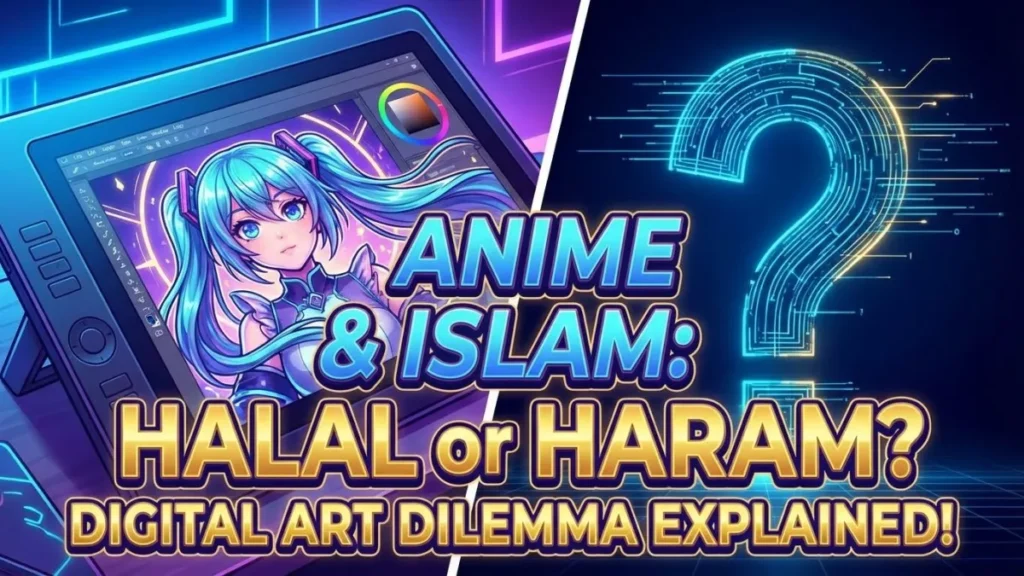
The Deoband school of Islamic thought takes a strict stance on picture-making. According to this tradition, creating images of living beings—whether by hand or digitally—is considered prohibited. However, there are specific exceptions for children’s toys and educational content. For Western Muslims interested in digital art careers, understanding these nuances is crucial for making informed decisions.
Key Takeaways
| Topic | Summary |
|---|---|
| Deoband’s Ruling on Drawing | Drawing, painting, and digital creation of living beings is prohibited; no difference between hand-drawn and digital art |
| Exception for Children’s Toys | Dolls and toys designed specifically for children’s education are permissible |
| Educational Content Exception | Some scholars permit educational animations that teach moral lessons and avoid depiction of sacred figures |
| Digital Art as Career | Creating images of animate beings for income is problematic under traditional interpretations |
| Alternative Artistic Paths | Islamic geometric design, calligraphy, landscape art, and inanimate object illustration are permissible |
| Western Muslim Perspective | Young Muslims in Western countries face unique challenges balancing cultural participation with traditional teachings |
What Does Drawing Anime & Cartoons Actually Mean?
When we talk about drawing anime and cartoons, we’re discussing creating visual representations of living beings—humans, animals, and fictional creatures that possess characteristics of life. This isn’t just about sketching on paper anymore. In today’s world, this includes digital art created on tablets, computers, and through animation software.
Here’s what falls under this category:
- Hand-drawn illustrations of people and animals
- Digital paintings and character designs
- Animated cartoons and anime productions
- 3D modeling of living creatures
- Character design for video games
- Comic book and manga artwork
- Animation frames showing movement of living beings
The key word here is “living beings.” This includes anything that has life characteristics—whether real or imaginary. An anime character, even though fictional, has human-like features and is therefore considered a depiction of a living form.
Read more: The Shocking Truth About Keeping a Dog Inside the House in Islam (Halal or Haram?)
Why This Topic Matters for You
You’re facing a real tension. If you’re a young Muslim in America, Canada, the UK, or other Western countries, you’re living in a society where visual art, animation, and digital design are everywhere. These are also booming career fields. The creative industries employ millions of people, and the skills are genuinely valuable.
But you also want to align your life with your faith. That’s where the confusion comes in.
Here’s why this matters:
- Career concerns: Many Muslims are interested in animation, graphic design, and digital art as professions. Understanding the ruling helps you make informed career choices.
- Personal hobbies: You might enjoy drawing or watching anime as entertainment. Knowing the perspective helps you decide what’s comfortable for you.
- Community guidance: Your family and community might have different opinions. Having clear information helps you navigate those conversations respectfully.
- Spiritual peace: Many Muslims want to feel confident that their choices align with their beliefs.
I’ve seen young Muslim artists struggle with guilt over their passion for anime and digital design. Some have abandoned promising careers. Others have continued without understanding the concerns. This article cuts through that confusion.
Understanding the Deoband School’s Perspective
The Deoband school of Islamic thought originated in India in the 1800s and has become one of the most influential interpretations of Islamic law, especially among South Asian Muslims and their descendants worldwide. When you’re asking about this topic, many Muslims—particularly those from Pakistani, Indian, and Bangladeshi backgrounds—are referencing Deoband teachings.
What Deoband Scholars Actually Say
Deoband’s position is based on strict interpretation of certain teachings. Let me explain this clearly without religious jargon.
The core principle is simple: making pictures of living things is considered a major sin in this interpretation. This isn’t a suggestion or a preference—it’s presented as a firm ruling.
Here’s the reasoning behind it:
- Historical concern about idolatry: The original teachings were issued when societies worshipped statues and images. The concern was that pictures could lead people to worship created things instead of believing in one God. This was a real problem in 7th-century Arabia.
- The concept of “copying creation”: Deoband scholars interpret certain teachings to mean that making pictures is seen as attempting to imitate divine creative power.
- Universal principle, changing methods: According to Deoband, even though methods of creating images have changed (from hand-drawing to photography to digital), the core principle remains the same.
Key Deoband scholars and their statements:
- Mufti Mahmud al-Hasan Gangohi: Photography has “absolutely the same ruling” as hand-drawn pictures. Both are prohibited.
- ‘Allamah Zafar Ahmad ‘Uthmani: Just changing the name from “picture” to “photograph” or “digital image” doesn’t change the ruling. It’s like calling alcohol by a different name—the prohibition remains.
- Mufti Shu’ayb ‘Alam: Digital pictures should be classified as pictures because “the essence and reality of picture-making are common to both” old and new methods.
The Deoband Position on Digital Art Specifically
This is important: Deoband scholars have explicitly addressed digital technology. They don’t accept the argument that “it’s just computer code” or “I didn’t use my hands.” According to their position, the digital method doesn’t change the ruling because the result is the same—a preserved image of a living being.
Pro Tip Box: Understanding Different Scholarly Opinions
Here’s something most people don’t realize: Even within Islam, there’s disagreement on this topic. Not all Muslim scholars agree with Deoband. Some other major schools of Islamic law have different opinions. The Maliki school, for example, takes a less strict view. Some contemporary scholars argue that non-realistic cartoons or animations created purely for entertainment and education might be permissible.
However, if you’re writing for an audience familiar with Deoband teachings, you need to know that this school holds a conservative position. It’s not the only position in Islam, but it’s an important one, particularly for South Asian Muslim communities.
Step-by-Step Breakdown: What’s Prohibited and What’s Permitted
Let me give you practical clarity on what Deoband’s interpretation actually prohibits and permits.
Step 1: Understand What’s Clearly Prohibited
According to Deoband scholars, these are prohibited:
- Drawing, painting, or digitally creating realistic images of people
- Anime and cartoon characters (because they depict living forms with human-like features)
- Photography of people and animals (same ruling as hand-drawn pictures)
- 3D modeling of animate beings
- Animation that shows movement of living creatures
- Sculptures and statues of people and animals
- Creating these images for any reason—hobby, profession, or education
- Earning money from creating such images
The prohibition applies regardless of:
- Whether you use your hands or a computer
- Whether the creature is real or fictional
- Whether the purpose is entertainment, education, or commerce
- How realistic or cartoon-like the image is
- Whether you’re doing it as a hobby or career
Step 2: Know the Specific Exceptions
This is important because there are limited exceptions recognized by Deoband scholars.
Exception 1: Children’s Toys
Dolls and toy figurines made specifically for children’s play are permitted. The reason? There’s historical evidence that scholars recognized children’s educational needs and made an exception. These toys are designed to help children learn practical skills like housekeeping and childcare.
Exception 2: Educational Content for Children
Some contemporary Deoband-influenced scholars have suggested that educational animations designed specifically to teach children good morals and Islamic values might be permissible—with conditions. This is a narrower exception and requires careful fulfillment of conditions.
Conditions for the educational exception:
- Content must be designed specifically for children
- It must teach moral and ethical lessons
- It must not include depictions of sacred religious figures
- It must not contain music, singing, or other prohibited elements
- The educational purpose must be genuine, not just a pretext
Exception 3: Inanimate Objects
Creating images, drawings, and designs of non-living things is clearly permitted. This includes:
- Landscapes and nature scenes
- Buildings and architecture
- Plants and flowers
- Geometric patterns and abstract designs
- Still life drawings
- Islamic calligraphy and arabesque designs
Step 3: Understand the Career Implications
If you’re considering a career in animation, digital art, or graphic design, here’s the practical reality based on Deoband teachings:
Creating images of living beings for income = Not permitted
According to Deoband scholars, earning money through creating pictures of animate beings is prohibited because the core act is prohibited. You can’t make a forbidden thing permissible just by being paid to do it.
However, there are permissible career paths:
- Graphic design focused on typography, logos (without animate beings), and layout
- Web design and user interface design
- 3D architecture visualization
- Landscape and environmental design
- Islamic geometric pattern design
- Calligraphy and Arabic script design
- Product design for inanimate objects
Expert Tips and Best Practices
I’ve studied how Muslims navigate this issue in Western countries. Here are practical insights:
Tip 1: Have a Honest Conversation with Yourself
Don’t pretend a question doesn’t exist if it bothers you. Some young Muslims ignore the teachings and feel guilty. Others strictly follow them but feel isolated from peers. The healthier approach? Understand the teaching, then make a conscious choice.
Ask yourself:
- Do I want to follow the Deoband interpretation strictly?
- Am I comfortable with a different scholarly interpretation?
- Can I find a creative path that aligns with my values?
There’s no shame in choosing any of these paths—but make it your own conscious choice, not just following habits.
Tip 2: Explore Permission for Inanimate Object Art
If you love digital art but want to follow Deoband’s teachings, shift your focus to inanimate objects. This isn’t settling—it’s genuinely creative. Some of the most stunning visual art in history focuses on non-living things:
- Architectural visualization and design
- Landscape and nature illustration
- Still life drawing
- Pattern and textile design
- Urban planning visualization
- Product design for everyday items
Tip 3: Consider Educational Purpose Carefully
If you want to work on educational animations for children, understand that this requires genuine educational purpose and careful execution. Don’t label something “educational” just to justify creating animate images. The scholars can usually tell the difference between genuine educational content and entertainment with a label slapped on it.
Tip 4: Learn Your Community’s Specific Stance
Deoband is broad. Different communities, mosques, and scholars within the Deoband tradition have slightly different applications. Talk to your local imam or scholar about how these teachings apply in your specific context.
Tip 5: Respect Both Choices
Whether your Muslim friend is a strict animator who disagrees with these rulings, or whether they refuse to draw anything living, both should be treated with respect. This isn’t a matter where there’s one obvious right answer that everyone agrees on. There’s theological disagreement among scholars, and people make different choices.
Common Mistakes to Avoid
Mistake 1: Thinking “Digital” Makes a Difference
Wrong thinking: “It’s okay because I’m using software, not actually drawing by hand.”
The reality: Deoband scholars have specifically addressed this. They don’t accept that digital methods change the ruling because the result—a preserved image of a living being—is the same.
Mistake 2: Believing Cartoon Style Changes the Rule
Wrong thinking: “Anime is too stylized and unrealistic to count as real pictures.”
The reality: Deoband scholars consider all images of living beings prohibited, whether realistic or highly stylized. The cartoon style doesn’t change the classification.
Mistake 3: Confusing Different Schools of Law
Wrong thinking: “Some Muslim scholars said it’s okay, so Deoband must also allow it.”
The reality: Deoband has a historically strict position on this. Other schools of Islamic law (like Maliki) take more lenient views. Know which tradition you’re following and what that specifically teaches.
Mistake 4: Thinking You Can Hide the Purpose
Wrong thinking: “I’ll say it’s educational so it becomes permissible.”
The reality: Making something genuinely educational requires real commitment to that purpose. Labeling entertainment content as “educational” is intellectual dishonesty, and most scholars see through this.
Mistake 5: Assuming Your Parents’ Generation Agrees
Wrong thinking: “My family follows Deoband, so they definitely disapprove of animation.”
The reality: Even within the same family and tradition, people interpret and apply these teachings differently. Some families are stricter, others more lenient. Have the actual conversation rather than assuming.
Real Examples: How This Works in Practice
Example 1: The Graphic Designer Dilemma
Situation: Amira is a 22-year-old Muslim woman in Toronto who loves graphic design. She studied it in college and has job offers from design agencies. However, most design work involves creating logos with images, brand illustrations with people or animals, and marketing materials with visual elements.
Analysis under Deoband:
- Creating logos with abstract animals = Prohibited
- Designing marketing materials with people’s images = Prohibited
- Creating font designs and pure typography = Permitted
- Designing packaging for inanimate products = Permitted
Practical solution: Amira could specialize in typography-based design, packaging design, or website layout design that doesn’t require creating images of living beings. She might also transition her skills to architectural visualization or interior design software, which is technically permitted.
Example 2: The Anime Enthusiast
Situation: Hassan is a 16-year-old Muslim who loves anime. He watches it regularly, draws anime characters, and dreams of becoming an animator. His parents, who follow Deoband teachings strictly, want him to stop.
Analysis:
- Watching anime = Arguably the lesser sin compared to creating it (though still problematic under Deoband)
- Drawing anime characters = Clearly prohibited under Deoband interpretation
- Career in animation = Not permissible under strict Deoband teachings
The conversation Hassan needs to have:
Rather than just being told “it’s forbidden,” Hassan needs to understand why it’s taught this way and then make his own choice. He might:
- Decide to strictly follow Deoband and find another career path
- Research other scholarly opinions and make an informed choice
- Pursue animation while accepting that it conflicts with one interpretation of his faith
- Find a middle path like animation of inanimate objects or motion graphics
Example 3: The Educational Animation Producer
Situation: Zainab and her team want to produce educational animations teaching Islamic history to Muslim children. They want to show historical figures and events visually.
Analysis under Deoband:
This is the most complex case because it’s the closest to the scholarly exception. However:
- If you’re depicting Prophets = Clearly prohibited, even in animation
- If you’re showing other historical Islamic figures = Still problematic under Deoband
- If you use alternative methods (flames for light, point-of-view shots, calligraphy representations) = Some scholars accept this
The execution: Zainab’s team could use creative storytelling without direct visual depiction. Many Islamic educational films do this successfully using narration, point-of-view shots (showing what the character sees), metaphorical representations, and beautiful calligraphy.
FAQ: Your Questions Answered
FAQ 1: Is Drawing Anime Specifically Haram?
Yes, according to Deoband teaching. Anime involves depicting living beings—human characters, animals, and creatures. Even though the characters are fictional and stylized, they still represent living forms. Deoband scholars classify all such depictions as prohibited, regardless of whether they’re realistic or cartoonish.
However, it’s important to know that some other Muslim scholars have more lenient views on highly stylized or non-realistic cartoon forms. But if you’re asking from the Deoband perspective specifically, the answer is clear.
FAQ 2: What About Photography? Is That Also Prohibited?
According to Deoband, yes. One of the most important clarifications Deoband scholars made is that photography has the same ruling as hand-drawn pictures. They explain that photography isn’t just a “reflection” like a mirror—it’s a preserved, durable image created through human effort (setting up the camera, lighting, composition, processing).
Mufti Kifayat Allah famously asked: “How does this reflection become transferred from the lens to the paper?” pointing out that the technical work involved makes photography equivalent to picture-making.
FAQ 3: Can I Create Digital Art if I Just Don’t Sell It?
No. The Deoband ruling doesn’t change based on whether you’re earning money from it or not. Creating images of living beings is prohibited whether you do it as a hobby or a profession, whether you sell it or just share it with friends.
The reasoning is that the core act—making a preserved image of a living being—is what’s prohibited, not the commercialization of that act.
FAQ 4: What About Video Games and 3D Animation?
Also prohibited under Deoband interpretation. Whether you’re creating 3D models for video games, virtual reality environments, or animated films, if those models depict living creatures, the Deoband ruling applies to it.
The method doesn’t matter—hand-drawn, 2D animation, 3D modeling, digital sculpture—all are classified the same way.
FAQ 5: Are There Any Modern Scholars Who Permit This?
Yes, there are differences of opinion. Some contemporary Muslim scholars argue that:
Non-realistic cartoon animations might be permissible because they’re clearly not attempting to be lifelike
The original prohibition focused on idolatrous worship of images, not entertainment
The spirit of the prohibition can be maintained while allowing educational and entertainment content
However, the Deoband school specifically maintains its strict position. If you’re asking what Deoband teaches, the answer is prohibition. If you’re asking whether all Muslim scholars agree, the answer is no.
FAQ 6: What Can I Actually Create as a Muslim Artist?
Many things. Permissible creative fields for Muslims following Deoband include:
Islamic geometric patterns and mathematical art
Calligraphy and Arabic script design
Landscape and nature illustration (but not animals)
Architecture and building visualization
Abstract art and modern art using non-representational forms
Still life drawing (fruits, objects, but not living beings)
Pattern design for textiles, wallpaper, and decor
Typography and font design
Web design and user interface design
Motion graphics that doesn’t depict animate beings
Graphic design focusing on layout, color, and composition
FAQ 7: If I’m Interested in Animation, What Should I Do?
Here are your real options:
Strict adherence path: Follow Deoband teaching strictly and pursue permissible creative fields instead. Many Muslim artists create beautiful work in these fields.
Researched decision path: Study different scholarly opinions, understand the reasoning, and make an informed choice about which interpretation resonates with you.
Career pivot path: If you’re already interested in animation, consider specializing in fields like motion graphics, kinetic typography, or architectural animation that might feel more aligned with your comfort level.
Middle-ground path: Some Muslims pursue animation while acknowledging the difference between their choice and their tradition’s teaching. This requires honest self-reflection and honest communication with family.
Community conversation path: Talk with your imam, family, and community about what’s right for you in your specific context rather than making assumptions.
FAQ 8: Does This Apply to Watching Anime, or Just Creating It?
Technically, yes—but differently. According to Deoband, watching images of living beings is also not encouraged. However, scholars generally consider it a lesser issue than creating them. The most severe warnings are directed at those who make or create images, not primarily at viewers.
This doesn’t mean watching anime is “totally fine,” but the concern is less intense than the concern about creating it.
FAQ 9: What’s the Difference Between This Teaching and Other Schools of Islam?
Significant differences exist. For example:
Maliki school: More permissive on drawings and images
Shafi’i school: Some scholars are more lenient than Deoband
Other contemporary scholars: May emphasize context and intent more than Deoband
Deoband is known for being stricter. If you’re raised in a Deoband tradition but encounter a Muslim friend from a different school with a different opinion, that’s not hypocrisy—it’s legitimate scholarly difference.
FAQ 10: How Do I Explain This to Non-Muslim Friends?
Simply and honestly: “In my Islamic tradition, creating pictures of living things is considered prohibited. It’s a practice from earlier centuries that some Muslim communities maintain. My tradition emphasizes geometric art and calligraphy instead. Other Muslims have different opinions on this.”
Most non-Muslim friends will understand this better than you’d expect. Many religions and cultures have specific practices that outsiders don’t immediately understand. Being clear and honest usually generates respect, not judgment.
What You Actually Need to Know
The honest truth about this topic is that you’re navigating multiple tensions simultaneously:
- Tradition vs. modernity: Your Islamic tradition has clear teachings, but you’re living in a visual, digital world where images are everywhere and image-creation is a legitimate profession.
- Scholarly diversity: Not all Muslim scholars agree on this issue. Deoband is strict, but it’s not the only voice in Islam.
- Personal choice: You’re not a child anymore. You have agency to make informed decisions about your faith practice.
- Community impact: Your choices affect how your family and community perceive your commitment to your faith.
Here’s what I’ve learned from talking with many young Muslim artists: The healthier path is informed choice, not guilt-driven avoidance or shame-filled engagement.
Final Conclusion and Action Steps
Here’s what to do with this information:
Step 1: Understand the Teaching
You now know what Deoband specifically teaches about drawing anime and digital art. It’s a prohibition based on specific religious principles. This teaching is coherent and serious.
Step 2: Clarify Your Own Position
Ask yourself honestly:
- Do I want to follow the Deoband interpretation strictly?
- Am I interested in learning about other scholarly perspectives?
- What feels right for my life and my faith?
Step 3: Have Real Conversations
- Talk to an imam or religious scholar you trust
- Talk to your family about these questions
- If you’re interested in animation, talk about what paths feel okay to you
- Be honest about your interests and concerns
Step 4: Make a Conscious Choice
Don’t just drift or follow assumptions. Make a decision that’s actually yours:
- If you’re following Deoband strictly, commit to permissible creative paths
- If you’re choosing a different approach, own that choice honestly
- If you’re uncertain, give yourself time to think
Step 5: Build Your Creative Path
Whether you’re pursuing permissible arts or making a different choice:
- Develop real skills
- Find mentors and community
- Create work you’re proud of
- Stay connected to your values
Final thought: Your Islamic tradition has beautiful artistic heritage—geometric patterns of breathtaking complexity, calligraphy that’s an art form in itself, architectural achievement that still amazes people. These traditions created stunning visual culture without depicting living things. You have access to that heritage. Whether you pursue that path or make a different choice is up to you—but make it a conscious one.
Additional Resources for Western Muslims
For deeper learning:
- Study Islamic geometric patterns and their mathematical principles
- Explore Islamic calligraphy as an art form
- Research the history of Islamic art and why these traditions developed
- Talk to your local Islamic school or mosque about these topics
- Read works by contemporary Muslim scholars who address modern questions about art and technology
For career planning:
- Explore architecture, interior design, and landscape design (permissible fields using visual skills)
- Consider motion graphics and kinetic typography
- Look into UI/UX design and web design
- Research Islamic pattern design and geometric art as a specialty
- Talk to Muslim professionals in various creative fields about their choices
For community connections:
- Find Muslim artist communities online and in your local area
- Join Islamic learning circles that discuss fiqh (Islamic jurisprudence) in depth
- Connect with other young Muslims navigating these exact questions
- Build relationships with mentors who’ve made these choices