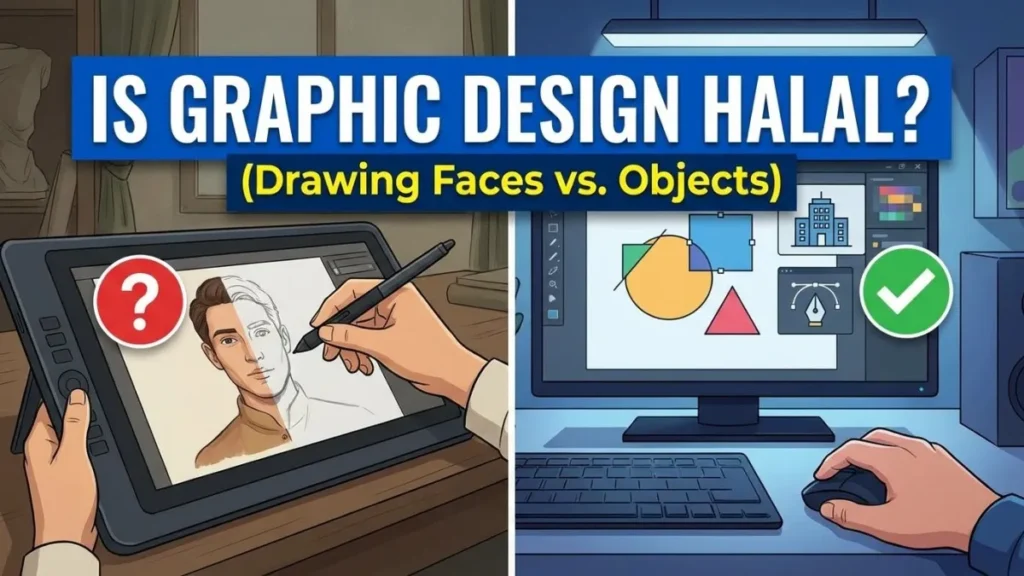
Graphic design is creating visual content to communicate messages. This includes logos, website designs, posters, social media graphics, packaging, and illustrations.
The Islamic concern isn’t about design itself. It’s about what you’re drawing and why.
Think of it this way: using your skills to create a beautiful Arabic calligraphy poster? That’s different from drawing realistic portraits of people for a magazine cover.
The scholars at Darul Uloom Deoband and other Islamic institutions focus on three main questions:
- Are you creating images of living beings (animate objects)?
- Is your work being used for halal or haram purposes?
- Are you creating physical idols or just digital/printed images?
Why This Topic Matters for Muslim Designers
You might think: “It’s just a job, why does it matter so much?”
Here’s why I care about getting this right, and why you should too.
Your income needs to be halal. Every dollar you earn feeds your family, pays your bills, and hopefully goes toward charity. If your income source is doubtful, it affects your entire life and even your duas.
You spend 40+ hours a week doing this work. That’s more time than you spend with your family. You need peace of mind that this time is blessed, not wasted or worse.
The Muslim community needs skilled designers. Mosques need beautiful websites. Islamic organizations need professional branding. Halal businesses need marketing materials. Your skills are valuable.
I’ve seen talented Muslim designers quit their jobs out of fear, only to realize later they could have made simple adjustments instead of abandoning the field completely.
Read more: Is Dropshipping from AliExpress Halal? 7 Powerful Truths About the Possession Issue in Islam
Understanding the Scholarly Positions on Image-Making
Let me walk you through what the major scholars actually say. This isn’t my opinion—I’m sharing established fiqh positions.
The Deobandi Position (Darul Uloom Deoband)
The scholars at Deoband are generally strict on this issue. Here’s their main stance:
Creating images of animate beings (humans and animals) is impermissible, even digitally or on paper. This includes:
- Drawing faces with complete features
- Realistic human figures
- Detailed animal illustrations
- Character design for people or animals
They base this on authentic hadiths where the Prophet ﷺ warned against image-makers.
However, they make exceptions for:
- Images needed for legal documents (passport photos, ID cards)
- Educational purposes (medical diagrams, scientific illustrations)
- Security and identification (CCTV, necessary documentation)
The key point from Deoband scholars: necessity makes prohibited things permissible, but only to the extent of that necessity.
What About Digital Images vs. Physical Drawings?
Some contemporary scholars make a distinction here. Let me explain both views.
Stricter View: Whether digital or physical, if you’re creating the image of a living being, the ruling is the same. A drawing on paper and a digital illustration both fall under the prohibition.
More Lenient View: Some scholars argue that digital images that exist only as pixels on a screen are different from physical drawings or sculptures. They don’t have the same “creation” element that the hadiths warned against.
I’ve found that most Deobandi-aligned scholars stick with the stricter view to be safe.
The Issue of Shadows and Incomplete Images
Here’s something interesting that might give you more room to work:
If the image is incomplete or shadowless, some scholars permit it. This means:
- Drawings without shadows (flat, 2D artwork)
- Faces missing key features (no eyes, or no nose, for example)
- Partial figures (just hands, or silhouettes)
- Simplified, cartoon-style characters that don’t resemble real beings
The logic? These aren’t truly “creating” a living image—they’re symbolic representations.
But again, stricter scholars say even this is better avoided.
Step-by-Step: Halal Graphic Design Career Paths
Now let’s get practical. How can you actually work in graphic design while staying within Islamic boundaries?
Step 1: Focus on Object-Based Design
This is your safest zone. Nobody questions these design types:
Typography and calligraphy
- Arabic calligraphy art
- English typography designs
- Quote graphics with beautiful fonts
- Logo designs using text
Abstract and geometric design
- Islamic geometric patterns
- Mandala-style artwork
- Abstract backgrounds
- Pattern design for textiles or wallpapers
Object and nature design
- Plant and flower illustrations
- Landscape designs
- Product mockups
- Food photography and design
- Architectural renders
I know several Muslim designers earning six figures focusing only on these areas. The market is huge.
Step 2: Specialize in Business and Brand Design
Here’s where the money really is—and it’s completely halal.
Logo design (text-based or abstract symbols)
- Most successful logos don’t use faces anyway
- Think: Apple, Nike swoosh, Microsoft
- Clients pay $500-$5,000+ per logo
Website design and UI/UX
- Layout design
- Button and interface elements
- Color schemes
- Navigation design
Marketing materials
- Brochures (without faces)
- Infographics
- Social media templates
- Presentation designs
Packaging design
- Product boxes
- Label design
- Bag and container design
Step 3: Set Clear Boundaries with Clients
This is crucial. You need a system to handle requests that cross your boundaries.
Create a clear policy:
“I specialize in logo design, branding, and abstract artwork. I don’t create realistic human or animal illustrations due to personal values.”
Most clients don’t care. They just want quality work. If you can’t do faces, they’ll either adjust the project or hire someone else for that specific part.
Alternative approach:
Work in a team where someone else handles character work while you handle everything else. This is common in design agencies.
Step 4: Understand the Grey Areas
Some design work falls in the middle. Here’s how I’d approach them:
Very simplified, cartoon-style mascots:
- Stricter view: Still avoid
- Personal decision: If it’s extremely simplified (circle head, dot eyes), some designers feel comfortable
- My advice: Ask a trusted local scholar about your specific style
Photo editing and manipulation:
- You’re not “creating” the image, just editing it
- Most scholars see this as permissible
- Used in halal contexts (business websites, product photos)
Icon design:
- Simple human/animal icons (like bathroom signs) are usually considered permissible by lenient scholars
- They’re symbolic, not realistic representations
- Stricter scholars still advise against it
Pro Tip: The “Necessity Rule” That Changes Everything
Here’s something many Muslim designers don’t know:
Islamic law recognizes necessity (darurah). If you’re in a situation where you have no other way to earn halal income, and your family depends on you, the ruling can change.
For example:
- You’re supporting elderly parents and this is your only marketable skill
- You live in an area with no other job opportunities
- You’re working toward transitioning but need income now
In these cases, scholars often advise:
- Make sincere intention to transition to fully halal design work
- Avoid the most problematic content (explicit images, idol-like creations)
- Actively work toward building skills in halal design areas
- Seek Allah’s forgiveness and make dua for better opportunities
This isn’t a free pass. It’s a temporary allowance while you work toward better options.
But it does mean you’re not sinning if you’re genuinely stuck and making efforts to improve your situation.
Expert Tips for Building a Halal Design Career
Let me share what I’ve learned from successful Muslim designers:
Tip 1: Market Yourself to the Muslim Community First
Muslim businesses are growing fast in the West. They need:
- Mosque websites and apps
- Islamic school branding
- Halal restaurant menus and branding
- Islamic bookstore designs
- Muslim fashion brand materials
- Charity organization graphics
These clients want designers who understand their values. You’re not a limitation—you’re an asset.
Tip 2: Master High-Value, Face-Free Skills
Focus on skills that pay well and don’t require drawing faces:
Motion graphics (text animations, logo reveals) 3D design (products, architecture, abstract scenes) Print design (magazines, books, posters with text/objects) Brand identity systems (complete visual language for companies)
These skills can earn you $75-$150+ per hour as a freelancer.
Tip 3: Use Islamic Aesthetics as Your Unique Selling Point
Islamic geometric art is trending worldwide. Non-Muslim clients love it too.
Position yourself as an expert in:
- Sacred geometry
- Islamic pattern design
- Arabic calligraphy integration
- Minimalist, spiritually-inspired design
Charge premium rates for this specialized knowledge.
Tip 4: Build Passive Income with Halal Templates
Create and sell:
- Islamic social media templates
- Ramadan graphics packs
- Eid card designs
- Islamic quote graphics
- Prayer time table templates
- Mosque announcement templates
Upload to Etsy, Creative Market, or your own website. Earn while you sleep.
Common Mistakes Muslim Designers Make
I’ve seen these mistakes hurt careers. Avoid them.
Mistake 1: Being Too Vague with Clients
Wrong: “I don’t do certain types of design.”
Right: “I specialize in brand identity, logo design, and geometric artwork. I don’t create realistic human or animal illustrations.”
Clear communication prevents awkward situations later.
Mistake 2: Thinking You Can’t Compete
Some Muslim designers think avoiding faces means they can’t succeed.
Reality: Most high-paying design work doesn’t involve faces at all.
- Corporate branding
- SaaS product design
- E-commerce design
- Publication layout
- Packaging design
These industries need you.
Mistake 3: Not Seeking Knowledge from Qualified Scholars
Don’t rely on random internet fatwas or what your friend said.
Find a qualified scholar you trust. Ask about your specific situation. Get personalized guidance.
Different madhabs have different rulings. Your school of thought matters.
Mistake 4: Ignoring the End Use of Your Work
Even if you’re designing “just objects,” ask what it’s for.
Halal clients: Islamic organizations, halal businesses, ethical companies
Questionable clients: Alcohol brands, gambling sites, adult content, interest-based banks
Your work is halal only if the end use is halal. A beautiful wine label is still haram income.
Mistake 5: Giving Up Too Easily
I’ve met designers who quit after one rejected project.
Building a specialized business takes time. Keep marketing yourself. The right clients will come.
Real Examples: How Muslim Designers Navigate This
Let me show you how real people handle this.
Example 1: Sara’s Logo Design Business
Sara is a Muslim designer in California. She only does logo design and brand identity.
Her approach:
- Clearly states she doesn’t do character design
- Focuses on text-based and abstract logos
- Charges $2,000-$5,000 per project
- Has a waiting list of Muslim and non-Muslim clients
Her income: $120,000/year working part-time from home
She’s never had to compromise her values.
Example 2: Ahmed’s Motion Graphics Studio
Ahmed creates animated explainer videos for tech companies.
His approach:
- Uses text, icons, and abstract shapes
- No character animation
- Focuses on B2B tech clients
- Specializes in SaaS product demos
His income: $150,000+/year
He turned his “limitation” into a unique minimalist style that clients love.
Example 3: Fatima’s Islamic Art Shop
Fatima creates Islamic geometric art and Arabic calligraphy.
Her approach:
- Sells prints on Etsy and her website
- Offers custom calligraphy services
- Teaches Islamic art online
- Works with mosques and Islamic schools
Her income: $60,000/year passive + client work
She built an entire business around purely halal art.
Frequently Asked Questions
1. Is it haram to work as a graphic designer?
No, graphic design as a profession is not haram. The issue is what you’re designing and for whom.
If you focus on halal content (text, objects, patterns, landscapes) and work for halal businesses, your income is completely permissible.
The concern arises when you’re creating realistic images of living beings or working for haram industries (alcohol, gambling, etc.).
2. Can I draw cartoon characters for children’s books?
This depends on the scholarly opinion you follow.
Stricter view (Deobandi): Even cartoon characters fall under the prohibition of creating animate images. Avoid this type of work.
Lenient view: Very simplified, non-realistic cartoons may be permissible, especially for educational purposes.
My advice: If you follow the Deobandi school, it’s best to avoid this. If you need clarification, ask a qualified scholar while showing them examples of your specific style.
3. What about editing photos of people for business websites?
Most scholars consider photo editing permissible because you’re not creating the image—you’re just modifying an existing photograph.
This applies to:
Color correction
Background removal
Layout and composition
Adding text overlays
However, you should still avoid working for haram businesses (dating apps, alcohol companies, etc.).
4. Are logos with animal symbols haram to design?
This is a grey area with different opinions.
Simplified, symbolic logos (like Twitter’s bird or Firefox’s fox) are generally considered permissible by lenient scholars because they’re not realistic representations.
Realistic animal illustrations would fall under the stricter rulings against animate images.
If you want to stay on the safest side, focus on text-based or abstract logos instead.
5. Can I make money selling Islamic-themed designs on Etsy or Creative Market?
Absolutely yes! This is a fantastic halal income source.
Islamic geometric patterns, Arabic calligraphy, Ramadan graphics, and Eid designs are in high demand.
Make sure your designs are:
Respectful of Islamic values
Don’t include Quranic verses in inappropriate contexts
Not used for disrespectful purposes
This can become a great passive income stream.
6. Is 3D modeling and rendering halal?
It depends on what you’re modeling.
Halal: Products, buildings, landscapes, furniture, vehicles, abstract objects
Questionable/Haram: Realistic human or animal models
3D modeling for architecture, product design, or game environments (without characters) is a great halal career path.
Many Muslim 3D artists earn excellent income doing architectural visualization and product rendering.
7. What if my job requires me to occasionally design something with faces?
If you’re employed and this is occasional, you have a few options:
Option 1: Discuss with your employer about focusing on other types of projects
Option 2: Ask if a colleague can handle those specific elements
Option 3: If it’s a necessity for your employment and you have no other job options, some scholars allow it under the principle of need (darurah) while you search for alternatives
Option 4: Start building freelance clients so you can eventually transition to your own business with full control
Don’t quit your job in panic. Make a strategic transition plan.
8. Are abstract human shapes (like silhouettes or stick figures) allowed?
Generally, yes, according to most scholars.
The prohibition focuses on realistic, detailed representations that resemble actual creation. Abstract, simplified representations are usually permissible.
However, if you want to be absolutely certain, stick to completely non-human designs.
9. Can I work for non-Muslim clients?
Of course! As long as:
The work itself is halal (no faces if you’re following strict opinion)
The client’s business is halal (no alcohol, gambling, adult content, interest-based finance)
The end use of your design is ethical
Many Muslim designers have thriving businesses serving non-Muslim clients in ethical industries.
10. How do I transition from haram design work to halal?
Here’s a practical transition plan:
Month 1-2: Start building a portfolio of halal design work (do pro bono for mosques, Islamic schools if needed)
Month 3-4: Begin marketing yourself as a specialist in your halal niche (brand design, pattern work, etc.)
Month 5-6: Take on freelance halal clients while still employed
Month 7+: Once freelance income reaches 50-75% of your salary, consider transitioning
Don’t quit abruptly. Build the bridge while you’re still crossing the old one.
Final Conclusion: Your Action Plan
Here’s what you should do right now:
Step 1: Clarify your own boundaries
Decide which scholarly opinion you’ll follow. Talk to a trusted local scholar if you’re unsure. Write down your clear boundaries.
Step 2: Audit your current work
Look at your portfolio. What percentage is clearly halal? What’s questionable? What’s definitely haram?
Step 3: Identify your halal niche
Based on your skills, pick 2-3 halal design areas to specialize in:
- Logo and brand identity
- Islamic geometric art
- Typography and calligraphy
- Web and UI design
- Packaging design
- Motion graphics
Step 4: Build your halal portfolio
Create 5-10 stunning portfolio pieces in your chosen niche. Do free work for mosques or Islamic organizations if needed.
Step 5: Start marketing
Create profiles on Upwork, Fiverr, or your own website. Clearly state your specialty. Reach out to Muslim businesses and ethical companies.
Step 6: Make dua and take action
Ask Allah to bless your work and provide halal income. Then take consistent action every single day.
Remember this: You don’t have to choose between your faith and your career. You can have both.
Thousands of Muslim designers are earning excellent halal income. You can be one of them.
The key is clarity, courage, and consistency.