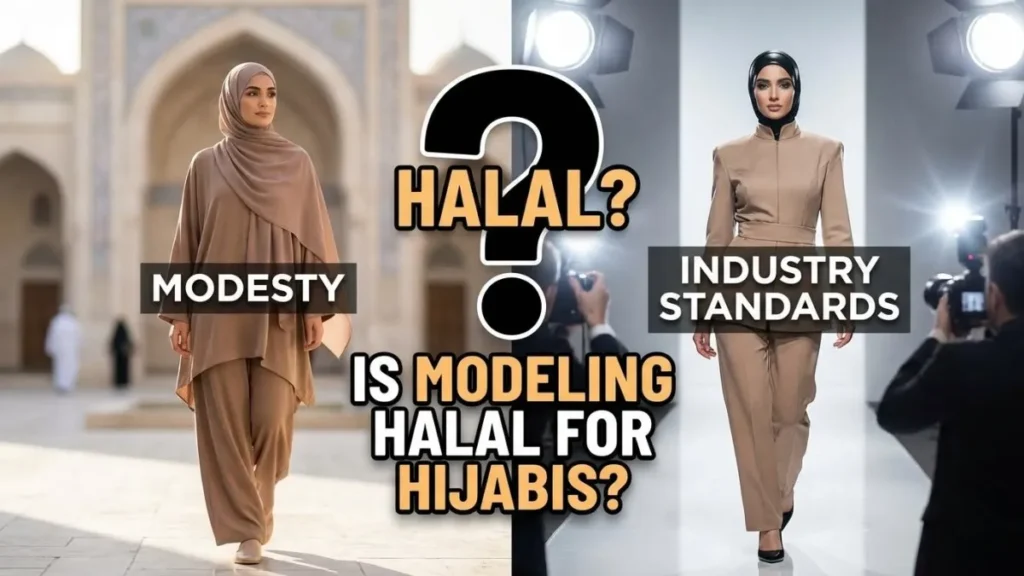
You’re scrolling through Instagram and see a beautiful hijabi modeling modest fashion. She looks confident, successful, and inspiring. But then doubt creeps in—is this actually allowed in Islam? Can a Muslim woman who wears hijab pursue modeling while staying true to her faith?
This question keeps many talented hijabi women up at night. I’ve spoken with dozens of Muslim women who dream of working in fashion but worry about crossing religious boundaries. The modeling industry has specific standards, and Islamic modesty has its own requirements. Can these two worlds coexist?
Let me walk you through everything you need to know.
Key Takeaways
Quick answers before we dive deep:
- Modest fashion modeling that adheres to hijab and Islamic guidelines has different rulings than conventional modeling
- The audience, product, and presentation style determine whether modeling work is permissible
- Scholarly opinions vary based on the specific type of modeling and how it’s executed
- Alternative career paths exist in fashion that align more clearly with Islamic values
- Your intention and execution matter significantly in determining permissibility
What Is Modeling in an Islamic Context?
Modeling means showcasing clothing, products, or brands through photographs, videos, or runway appearances. But in Islam, we need to break this down further.
Not all modeling is the same. There’s a huge difference between:
- A hijabi woman modeling abayas for a Muslim-owned online store
- Walking a high-fashion runway in revealing clothing
- Appearing in cosmetics ads with full hijab
- Doing fitness modeling in tight athletic wear
The Islamic ruling changes based on what you’re modeling, how you’re presenting yourself, and who’s viewing the content.
From a Deobandi fiqh perspective (which I’ll reference throughout), scholars examine several factors: Does the work involve displaying beauty to non-mahram men? Does it require compromising hijab? Does it lead to fitnah (temptation)?
The Three Categories of Modeling
Category 1: Clearly Problematic
- Revealing clothing or swimwear
- Intimate apparel advertising
- Beauty shoots with provocative poses
- Mixed-gender runway shows with physical contact
- Any work requiring hijab removal
Category 2: Gray Area (Needs Careful Evaluation)
- Modest fashion modeling for public audiences
- Cosmetics advertising while maintaining hijab
- Social media influencer content
- Brand ambassadorship roles
- Commercial photography for modest products
Category 3: Generally More Acceptable
- Modeling for women-only audiences
- Educational fashion content
- Product demonstration (not focused on personal beauty)
- Behind-the-scenes fashion industry roles
- Modest fashion design and consultation
Why This Topic Matters for Muslim Women
This isn’t just about career choices. It’s about your identity, your financial independence, and your relationship with Allah.
I’ve seen talented Muslim women feel torn between their creative passions and their faith. Some abandon their dreams entirely. Others compromise their values and later feel guilty.
The truth? You don’t have to choose between success and faith. But you do need clarity on what Islam actually permits.
The Financial Reality
Many hijabi women need to earn income. Modeling can pay well—sometimes very well. But earning money through impermissible means doesn’t bring barakah (blessing).
According to Islamic principles, your income source matters as much as the amount you earn.
The Representation Question
Some sisters argue: “We need Muslim representation in fashion! If we don’t model, who will show that hijabis can be fashionable?”
This is a valid concern. But representation cannot come at the cost of violating Islamic boundaries. There are ways to represent modest fashion without compromising Islamic guidelines.
The Slippery Slope
I’ve watched many sisters start with “innocent” modest fashion content, then gradually shift toward more revealing material as they chase engagement and income.
The modeling industry has strong pressures. Photographers push for “just one shot” without hijab. Brands request tighter clothing. Social media algorithms favor more revealing content.
You need to know your Islamic boundaries before you enter this space.
Read more: 7 Proven Halal Rules for Successful Muslim YouTubers
Islamic Guidelines: What Scholars Say
Let me be direct: most traditional Deobandi scholars advise extreme caution or outright prohibition regarding modeling work, even modest fashion modeling.
The Core Islamic Principles Involved
Principle 1: Guarding Beauty (Hifz al-Zinah)
Allah commands in the Quran that women should not display their beauty except to specific family members (mahrams). Modeling, by definition, involves displaying your appearance to strangers.
Even if you’re fully covered, you’re still intentionally attracting attention to your appearance.
Principle 2: Avoiding Fitnah (Temptation)
Islamic law emphasizes blocking the means to sin (sadd al-dhara’i). Even if your modeling is modest, if it leads others to temptation or inappropriate thoughts, it becomes problematic.
This is where many sisters get confused. They think: “I’m wearing hijab, so it’s fine.” But scholars ask: What is the purpose and effect of your appearance?
Principle 3: The Male Gaze
When non-mahram men view your images or videos, even if you’re modestly dressed, there’s a violation of the Islamic principle of lowering the gaze.
You can’t control how others look at you, but you can control whether you put yourself in that position.
What Deobandi Scholars Specifically Say
According to rulings from Darul Uloom Deoband and similar institutions:
Photography for modeling purposes is generally discouraged because:
- It involves displaying oneself to non-mahram viewers
- The images are permanent and widely distributed
- It often involves beautification beyond normal presentation
- The intention is to attract attention to physical appearance
Even modest fashion modeling raises concerns:
- The focus remains on your physical appearance
- Non-mahram men will view the content
- It can lead to pride and vanity
- The fashion industry environment often conflicts with Islamic values
Social media modeling has additional issues:
- Comments from non-mahram men
- Continuous need to post attractive content
- Algorithm-driven pressure to show more
- Public nature of the content
Step-by-Step: Evaluating Your Specific Situation
Let me help you think through your particular circumstances.
Step 1: Define Exactly What You’re Considering
Be specific. Write down:
- What products would you model?
- Who is the target audience?
- Where would the content appear?
- Who would see it (women only, or public)?
- What would you wear?
- How would you pose or present yourself?
Example: “I want to model abayas for an online modest fashion store. The photos would appear on their website and Instagram. I would wear full hijab and loose clothing. The audience is mostly Muslim women, but the content is public.”
Step 2: Apply the Islamic Tests
Ask yourself these questions:
Test 1: The Hijab Test
- Does this require any compromise in your hijab?
- Would your clothing be tight or form-fitting?
- Would your face be the focal point?
Test 2: The Audience Test
- Will non-mahram men view this content?
- Is the content targeted at women only?
- Can you restrict who sees it?
Test 3: The Intention Test
- Why are you doing this? (Be brutally honest)
- Is it for income, fame, validation, or genuine service?
- Would you be comfortable explaining this to Allah?
Test 4: The Environment Test
- Would you work with male photographers alone?
- Does the company respect Islamic boundaries?
- Would there be pressure to compromise later?
Test 5: The Consequence Test
- Could this lead to sins (pride, showing off, seeking attention)?
- Might it influence others negatively?
- What message does it send about Muslim women?
Step 3: Seek Qualified Scholarly Opinion
Here’s what many sisters skip: actually asking a knowledgeable scholar.
Don’t just ask your friend or check social media. Find a qualified mufti or scholar who:
- Understands Islamic jurisprudence deeply
- Knows the reality of the modeling industry
- Can give you a ruling based on your specific situation
Contact institutions like:
- Darul Uloom Deoband (or their international branches)
- Trusted local Islamic centers with qualified scholars
- Online fatwa services from recognized institutions
Pro Tip Box: When you ask a scholar, provide ALL the details—don’t sugarcoat or hide aspects that might make it sound less permissible. You need an honest answer, not the answer you want to hear. I’ve seen sisters ask vague questions to get lenient rulings, then convince themselves they’re following Islam while clearly violating boundaries.
Step 4: Consider the Alternative Career Paths
Before diving into modeling, explore these options that have clearer Islamic permissibility:
Fashion Industry Alternatives:
- Modest fashion designer
- Fashion blogger (focusing on styling, not personal appearance)
- Fashion business owner
- Modest fashion consultant
- Fashion illustrator or graphic designer
- Fashion photographer (for women-only shoots)
- Styling and wardrobe consulting
Related Creative Fields:
- Graphic design for fashion brands
- Social media management (behind the scenes)
- Fashion writing and journalism
- Product photography (objects, not people)
- Fashion education and teaching
These paths let you engage with fashion without the problematic aspects of modeling.
The Women-Only Exception: A Possible Path?
Some scholars provide a conditional permission for modeling in women-only environments.
What This Means
If you model exclusively:
- For women-only publications
- At women-only fashion shows
- In women-only spaces
- With female photographers only
- Where no men will see the content
Then the primary concern (displaying beauty to non-mahram men) is removed.
The Practical Challenges
But here’s the reality I need you to understand:
Most “women-only” content doesn’t stay that way. Images leak online. Videos get shared. Someone’s husband sees it. The content goes viral.
Even professional women-only magazines often have:
- Male editors or executives
- Male printing and distribution staff
- Public accessibility
I’ve spoken with sisters who started modeling for “women-only” audiences, only to find their images circulating on public Instagram pages and Pinterest boards.
The Deobandi Perspective on This
Even with women-only audiences, Deobandi scholars raise concerns:
- The work still involves beautification and displaying yourself
- It can lead to pride, vanity, and competition
- The fashion industry environment may compromise your Islamic character
- The income source, while not clearly haram, is questionable (mashbooh)
Their general advice: If you need income, pursue clearer, unquestionable paths. Why risk spiritual harm for a career with so many Islamic concerns?
Common Mistakes Muslim Women Make
Let me be frank about errors I see repeatedly.
Mistake 1: “It’s Modest Fashion, So It’s Fine”
Just because you’re wearing hijab doesn’t automatically make modeling permissible.
The intention behind modeling is to attract attention to your appearance—even if modest. This conflicts with the Islamic principle of not displaying beauty publicly.
Mistake 2: “I’m Inspiring Other Muslims”
Some sisters justify modeling by saying they’re providing positive representation for Muslim women.
But ask yourself: Are you really inspiring faith, or are you building a personal brand?
True inspiration comes from teaching Islam, sharing knowledge, and demonstrating piety—not from looking fashionable in photos.
Mistake 3: “The Money Is Good and I Need It”
Financial need doesn’t make impermissible income permissible.
If modeling is problematic, then the money earned from it lacks barakah. I’ve seen sisters earn thousands from modeling, only to face constant problems with the money—unexpected expenses, family issues, or feeling spiritually empty despite financial success.
Mistake 4: Shopping for Lenient Opinions
This is big. Sisters will ask ten different people until someone says “it’s okay,” then follow that opinion.
This isn’t how Islamic jurisprudence works. You should follow scholars known for their knowledge and piety, not just whoever gives you the answer you want.
Mistake 5: “I’ll Just Do It Temporarily”
Many think: “I’ll model for a few years, make money, then stop.”
But temporary income from questionable sources still affects you. Plus, those images remain online forever. Years later, when you’re more practicing, those photos will still exist.
Mistake 6: Ignoring the Environment
Even if the specific act of modeling could be permissible in theory, the fashion industry environment often isn’t.
You’ll face:
- Pressure to compromise gradually
- Interactions with non-practicing or non-Muslim colleagues
- Environments that normalize un-Islamic behavior
- Constant focus on physical appearance and materialism
This environment can weaken your faith over time.
Real Examples: Learning from Others’ Experiences
Let me share some real scenarios (names changed for privacy).
Example 1: Amina’s Story
Amina started modeling hijabs for a small Muslim-owned business. She thought it was completely fine because:
- She wore full hijab
- The products were Islamic
- The brand was Muslim-owned
But within six months:
- The brand expanded to mainstream fashion sites
- Non-Muslim men began commenting on her photos
- Other companies reached out asking her to model non-modest items
- She felt pressure to post more frequently to maintain engagement
- Her self-worth became tied to likes and comments
She eventually quit, realizing that even “modest fashion modeling” had compromised her relationship with Allah. She felt she was more focused on looking good than being good.
Example 2: Zainab’s Approach
Zainab wanted to work in fashion but chose a different path. She:
- Started a modest fashion blog focusing on styling tips (not modeling photos of herself)
- Used flat-lay photography and product-only shots
- Created content about finding modest clothing
- Built a business selling modest fashion items
- Hired other women to model (she didn’t appear in content)
Her business succeeded, and she maintained clear Islamic boundaries. No one questioned the permissibility of her work.
Example 3: Fatima’s Mistake
Fatima began modeling for women-only fashion shows. She convinced herself it was fine because:
- Only women attended
- The shows were private
- She wore modest clothing
But problems arose:
- Attendees took photos and posted them online
- Her images appeared on public social media
- Male relatives of attendees saw the photos
- She became known as “that model sister”
- Her marriage prospects were affected (some families declined because they disapproved)
She learned that “women-only” spaces don’t guarantee privacy in the digital age.
Expert Tips and Best Practices
If you’re determined to work in fashion while maintaining Islamic boundaries, here’s my advice:
Tip 1: Stay Behind the Camera, Not In Front
Be the photographer, designer, stylist, or brand owner—not the model. This removes 95% of the Islamic concerns.
Tip 2: If You Must Model, Set Firm Boundaries
Create a written list of your non-negotiables:
- No male photographers (female only)
- No tight or form-fitting clothing
- No face close-ups or beauty-focused shots
- No public social media posting
- No mixed-gender events
- Right to approve all images before publication
Stick to these boundaries even if it costs you opportunities.
Tip 3: Prioritize Women-Only Spaces (But Verify)
If you work in women-only contexts:
- Get written guarantees about image usage
- Require watermarks preventing sharing
- Work only with companies that respect Islamic boundaries
- Regular check where your images appear
- Have legal agreements about distribution
Tip 4: Keep Your Face Secondary
If you must appear in content, make the product the focus, not you:
- Use shots that show clothing without emphasizing your physical features
- Avoid close-up facial photos
- Position yourself to showcase the product, not your beauty
- Choose angles that minimize attention to your appearance
Tip 5: Regularly Consult With Scholars
Don’t just ask once and assume you’re fine forever. As your work evolves, keep checking:
- Schedule quarterly check-ins with a trusted scholar
- Show them your actual work content
- Ask about specific situations as they arise
- Adjust based on their guidance
Tip 6: Watch for Spiritual Warning Signs
If you notice these signs, it’s time to reevaluate:
- You obsess over your appearance more than before
- Your prayers feel empty or rushed
- You feel pride or arrogance about your looks
- You crave validation from likes and comments
- You hide your work from pious family members
- You feel guilty but push the feeling away
- You’re defensive when questioned about permissibility
These are signs that the work is affecting your spiritual health.
FAQ: Your Questions Answered
1. Is it permissible for a hijabi to model modest clothing for Muslim brands?
The majority of traditional Deobandi scholars advise against this because it still involves displaying your appearance to non-mahram men (even if you’re covered), and the purpose is to attract attention to your looks. If the audience is strictly women-only and you can guarantee no men will view the content, some scholars may allow it, but this is extremely difficult to ensure in the digital age. The safer option is to work in fashion without modeling yourself.
2. Can I be a social media influencer as a hijabi without it being problematic?
It depends on your content type. If you’re creating educational content, tutorials, or product reviews where the focus is information (not your appearance), this has less Islamic concern. But if your content centers on showcasing yourself, taking beauty-focused selfies, or building a following based on your looks (even modestly dressed), then the same issues as modeling apply. Focus on providing value through knowledge, not through displaying yourself.
3. What if I only post fashion content for women to help them find modest clothes?
Your intention is good, but ask: do you need to model the clothes yourself, or can you share the information without appearing in the content? Many successful modest fashion accounts use flat-lay photography, product shots, or have others model. This achieves the goal of helping women without the Islamic concerns of modeling. The question isn’t whether your intention is good, but whether your method is Islamically sound.
4. Is modeling for a women-only fashion show permissible?
This is less problematic than public modeling, but challenges remain: ensuring the space is truly women-only, preventing photography/recording, controlling image distribution, and guarding against spiritual harm (pride, vanity). Even with women-only audiences, many Deobandi scholars discourage it because the focus remains on displaying yourself. If you proceed, take extreme precautions: female-only staff, no recording devices, strict entry control, and written agreements about privacy.
5. What about modeling for my own modest fashion business?
This is still modeling, with the same Islamic concerns. The fact that it’s your business doesn’t change the ruling. Better alternatives: hire models who work in women-only spaces, use mannequins or flat-lay photography, create illustration-based marketing, or focus on product-only photography. Your business can succeed without putting yourself in front of the camera.
6. If I wear niqab (face covering) while modeling, does that make it permissible?
Covering your face removes one layer of concern, but doesn’t resolve all issues. You’re still displaying your body shape and form, still intentionally attracting attention, and still working in an environment that may compromise Islamic values. Niqab is excellent for privacy in daily life, but using it to justify modeling doesn’t address the fundamental questions about the work itself. Consult a scholar about your specific situation.
7. Can I model if I really need the money for my family?
Financial need doesn’t make impermissible income permissible. If modeling is problematic, seek alternative income sources—there are many ways to earn money that don’t involve Islamic concerns. Consider: freelancing, teaching, halal business ventures, online work, or other fashion industry roles (design, styling, consultation). Allah promises to provide for those who fear Him and seek halal income. Don’t let financial pressure push you into questionable earnings.
8. What do I do if I’ve already been modeling and now feel it’s wrong?
First, make sincere repentance (tawbah) to Allah. Second, stop the work immediately—don’t wait until your “contract ends” or you “make enough money.” Third, request that companies remove your images (though they may not comply). Fourth, use your experience to advise others. Fifth, seek alternative career paths. Allah loves those who repent and change. Your past doesn’t define your future. Many sisters have successfully transitioned away from modeling into more clearly permissible work.
9. Are there any types of modeling that are clearly permissible in Islam?
Product modeling (showcasing items without emphasizing your appearance), educational demonstrations (showing how to wear hijab, for example, in purely instructional contexts), and working in completely private women-only environments with strict privacy controls come closest to permissibility—but even these require careful implementation and scholarly consultation. The safest approach is to contribute to the fashion industry in ways that don’t involve modeling yourself. No career is worth risking your relationship with Allah.
10. How do I know if a scholar’s opinion on modeling is reliable?
Look for scholars who: have formal Islamic education (ideally from recognized institutions), understand fiqh (Islamic jurisprudence) deeply, are known for piety and God-consciousness (not just knowledge), don’t chase popularity or give convenient rulings, and ask detailed questions about your situation (not giving generic answers). Be wary of “influencer scholars” or those who give suspiciously lenient rulings without proper inquiry. When it comes to matters this important, prioritize scholarly rigor over convenience.
Final Conclusion: Making Your Decision
I know this is a difficult topic. You might have dreams of working in fashion, and modeling seems like the obvious path. But as Muslims, we don’t choose careers based only on our dreams or financial gain.
Here’s what I want you to understand:
The majority of traditional Islamic scholars—especially in the Deobandi tradition—advise against modeling work, even modest fashion modeling. The concerns are serious: displaying yourself to non-mahram men, attracting attention to your appearance, working in problematic environments, and risking spiritual harm.
This doesn’t mean you can’t work in fashion. It means you need to find ways to engage with fashion that clearly align with Islamic boundaries.
Your Action Steps
Step 1: Be honest with yourself about your intentions. Are you seeking validation, fame, money, or genuine service? Write this down privately.
Step 2: If you’re currently modeling, pause and reevaluate. Don’t justify questionable work just because you’ve already started.
Step 3: Consult with a qualified scholar. Share your specific situation completely and honestly. Don’t shop for lenient opinions.
Step 4: Explore alternative career paths in fashion that don’t involve modeling yourself. Get creative—there are many ways to succeed.
Step 5: Make du’a (supplication) for guidance. Ask Allah to open permissible doors and close impermissible ones. Trust His plan for you.
Step 6: If you feel unsure about permissibility, that’s your sign. When in doubt, the safer path is to avoid it. The Deobandi approach emphasizes caution (wara’) in uncertain matters.
The Ultimate Question
Ask yourself: If you died tonight and stood before Allah, would you be comfortable explaining this career choice to Him?
If the answer is no, or if you feel even slight discomfort, that’s your conscience speaking. Listen to it.
Final Thoughts
Success in this life isn’t measured by Instagram followers, brand deals, or modeling contracts. Real success is earning Allah’s pleasure while making a halal living.
You don’t need to model to matter. You don’t need to display yourself to have worth. Your value comes from your faith, character, and contributions—not from your appearance.
There are countless ways to earn income, pursue creativity, and work in fashion without compromising your Islamic boundaries. Choose the path that lets you meet Allah with a clear conscience.
May Allah guide you to what is best for your deen (faith) and dunya (worldly life), and may He protect you from all that would harm your relationship with Him.