
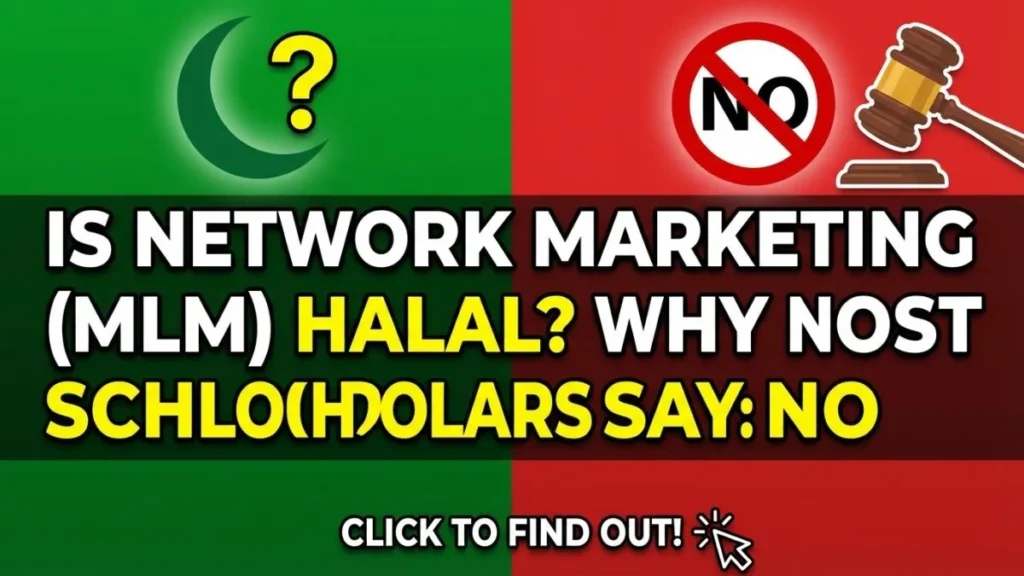
Most Islamic scholars and financial experts say network marketing (MLM) schemes are not allowed (haram) because they rely on recruitment instead of real product sales, involve uncertainty and deception, and cause 99% of participants to lose money. If you’re looking for ethical ways to earn, there are better alternatives that don’t put your savings and relationships at risk.
Key Takeaways
- 99% failure rate: Research shows that 99.6% of MLM participants lose money after expenses
- Scholar consensus: Islamic authorities from the Deoband tradition and other schools forbid MLM due to prohibited elements (riba, gharar, maysir)
- Pyramid structure: MLM schemes are structurally similar to banned pyramid schemes—they prioritize recruitment over product sales
- Financial devastation: People lose savings, take on debt, and damage family relationships trying to make MLM work
- Better alternatives exist: Freelancing, ethical e-commerce, and skill-based work offer legitimate halal income without exploitation
What Is Network Marketing (MLM) and Why Should You Care?
Before diving deeper, let me be clear: I’ve seen too many good people lose their life savings to MLM schemes. That’s why I’m writing this.
Network marketing, also called multi-level marketing (MLM), is a business model where people make money in two ways:
- Commissions from selling products they recruit other people to sell
- Bonuses from recruitment — meaning they earn money when they bring new people into the scheme
On the surface, it sounds like a normal sales job. But here’s the problem: most MLM schemes make far more money from recruitment than from actual product sales. This is what makes them dangerous—especially for Muslims trying to follow ethical business principles.
Think of it like this: If a company is more excited about you recruiting your friends than them buying products, that’s a red flag. That structure is why most MLM participants end up losing money.
Why This Matters: The Real Impact of MLM on Your Life and Faith
Here’s what I need you to understand: MLM isn’t just a bad financial decision. It’s a test of your faith and a threat to your community.
Financial Impact
The numbers are shocking but true:
- 99.6% of MLM participants lose money (after all expenses)
- Only 1 person out of 545 makes money after expenses
- The average person makes less than 70 cents per hour
- Many participants take on credit card debt to stay in the scheme
Emotional and Social Cost
Beyond money, MLM destroys relationships:
- People feel shame and depression after realizing they’ve been deceived
- Friendships break when you recruit friends who also lose money
- Family members become uncomfortable when you constantly try to recruit them
- People report isolation, paranoia, and deep anxiety after leaving MLM schemes
Islamic Perspective
For Muslims, MLM violates core principles of halal income:
- It involves gharar (uncertainty and deception)
- It uses maysir (gambling-like elements)
- The goal is recruitment not genuine sales
- It exploits vulnerable people in close-knit communities
The Three Big Islamic Problems With MLM: A Simple Breakdown
Let me explain the Islamic perspective in a way that makes sense.
1. Gharar — Too Much Uncertainty and Deception
Gharar means excessive uncertainty in a contract or deal. In a halal business, you know:
- What you’re buying
- What it costs
- What you’re likely to earn
In MLM, none of this is clear:
- The company promises you can earn “unlimited income” but doesn’t show you real data
- Most people make nearly nothing, but you’re told you can get rich if you work harder
- Your success depends on recruiting people under you, which you can’t control
- Products are often overpriced and not meant to be sold to real customers
Islamic scholars say this deception violates basic fairness in business. You’re not entering a contract where both sides understand the reality.
2. Maysir — It’s Like Gambling, Not Real Business
Maysir means gambling or speculation. Islam forbids making money through chance or luck rather than real work.
Here’s how MLM is like gambling:
- You pay money to join (like buying a lottery ticket)
- Your chances of winning depend on luck and timing (like gambling odds)
- The vast majority loses money (like casino games)
- A tiny percentage at the top wins big (just like casino owners)
The difference is: at least a casino is honest about the odds. MLM companies claim you can make money, when the statistical reality is you won’t.
3. The Fundamental Problem: It’s Haram Because It’s Built on Deception
Here’s the clearest point: Real businesses sell products. MLM schemes sell recruitment.
When a company makes more money from bringing in new people than from selling actual products to real customers, that’s not business—that’s a pyramid scheme. And pyramid schemes are explicitly haram (forbidden) in Islam.
Why? Because:
- You’re not creating real value
- You’re taking money from people below you
- The people at the bottom lose money to pay those at the top
- This is considered theft and exploitation under Islamic law
What Islamic Scholars Actually Say About MLM
Let me show you the evidence from trusted Islamic sources.
The Deoband Perspective (Hanafi School)
The Deoband tradition (Darul Uloom Deoband) is one of the most respected Islamic institutions in the Muslim world. On network marketing, Deoband scholars are clear: the chain system (MLM) is absolutely not permissible.
According to Deoband fatwas:
- Products can be halal, but using a chain system to sell them is forbidden
- Even if the product itself is permissible, the way it’s distributed through MLM is haram
- If the business requires recruitment to make money, it’s definitely not allowed
Deoband teaches that Muslims should avoid these schemes completely, regardless of what the products are.
The Majority Opinion Among Scholars
Here’s important: Multiple Islamic schools of thought agree that MLM is haram:
| Islamic Authority | Position | Reason |
|---|---|---|
| Deoband (Hanafi) | Forbidden | Chain system is inherently exploitative |
| Saudi Arabia Fatwa Council | Forbidden | Resembles pyramid schemes, violates Islamic principles |
| Malaysia’s JAKIM | Conditional (very strict) | Only allowed if recruitment bonuses are forbidden |
| Dr. Muhammad Salah | Forbidden | Focuses on recruitment, not real product sales |
| IslamQA.org | Forbidden | Exploits vulnerable people and communities |
The consensus is clear: Even scholars who might permit some forms of direct sales absolutely forbid the chain/pyramid structure of modern MLM.
How MLM Works: The Structure That Guarantees Most People Lose
Understanding how MLM actually operates will show you exactly why it fails.
Step 1: You Join and Pay Money
First, you’re asked to join. This might cost:
- Anywhere from $500 to $15,000 (depending on the MLM)
- Monthly subscriptions to “stay active”
- Mandatory purchases of “starter kits” or product inventory
- Training fees and materials
The company claims you’ll make this back quickly. But here’s the problem: most people never do.
Step 2: You’re Told to Recruit
Now comes the pressure. Uplines (people above you) push you to:
- Recruit friends and family
- Host meetings and presentations
- Spend hours on social media promoting the “opportunity”
- Tell people they can “get rich” (even though you’re not making money)
Pro Tip: If anyone is pushing you to recruit people instead of helping you sell products, that’s a sign the business model is broken. Real sales jobs focus on selling, not recruiting.
Step 3: The Math Doesn’t Work
Here’s where it gets depressing. Let’s say you recruit 10 people below you:
- You get commissions from their sales
- But they also have to recruit people to make money
- The system can only work if people at the bottom keep recruiting
- But there are only so many people in your network
Eventually: No one can recruit anymore. The pyramid collapses. People lose money.
Step 4: People Leave Broken
According to research, within a few years:
- 95% of people have quit or are inactive
- Most have lost money
- Many carry debt from buying inventory
- Relationships with friends and family are damaged
This isn’t a business model—it’s a cycle of loss.
Real Examples: What Happens to MLM Participants
Let me share some real stories (names changed) to show you what actually happens:
Example 1: Ragh’s Story
Ragh was a young professional who got approached by an MLM recruiter promising “passive income” and “financial freedom.” He invested his savings—about $5,000—to get started.
The reality:
- He spent 30-40 hours per week recruiting, not selling
- He made less than $200 in the first month
- His friends started avoiding him because he kept trying to recruit them
- After 6 months, he’d lost $4,500
- The shame was so intense he couldn’t even talk to his family
His advice today: “I wish someone had shown me the math. 99% of people lose money. Why would I think I’d be in the 1%?”
Example 2: Ria’s Struggle
Ria, a divorced mother, was struggling financially when someone offered her an MLM “opportunity.” She saw other Muslim women in the business and thought it was safe.
What actually happened:
- She took a loan to join (a huge red flag)
- Senior members would berate people in WhatsApp groups
- When she questioned the numbers, she was told to have more “faith”
- She eventually left after losing $3,000
- It took her a year to recover emotionally from the depression
Her warning: “These schemes target vulnerable people—people like me who needed money. They use your community against you.”
Example 3: The Family That Lost Together
A family of 5 (parents and 3 adult children) all joined the same MLM scheme. They thought doing it together would help.
The outcome:
- Combined losses: $25,000
- Relationships: Severely damaged because some blamed others for recruiting them
- Trust: Broken because they felt their own family members had exploited them
- Recovery: Still trying to rebuild relationships 2 years later
The Red Flags: How to Spot a Haram MLM Before It’s Too Late
Before you join any “business opportunity,” check for these warning signs:
Red Flag #1: Recruitment Over Sales
- They focus on “recruiting” not “selling”
- You make more from bringing people in than from actual sales
- Most of your meetings are about recruitment, not product education
Red Flag #2: Emphasis on “Getting Rich Quick”
- Presentations show photos of fancy cars and vacations
- They promise “unlimited income potential”
- They claim you can do this “part-time” and get rich
- They use emotional language like “life-changing opportunity”
Red Flag #3: Required Purchases
- You must buy inventory to “stay active”
- You’re pressured to buy training materials
- Monthly subscription fees are mandatory
- You’re expected to use/buy products yourself
Red Flag #4: Targeting Your Community
- Friends or family members approach you
- It’s popular within your ethnic or religious community
- They use trust and community bonds to recruit
- Existing members tell you “everyone’s doing it”
Red Flag #5: Vague Income Disclosure
- They don’t show real income data
- When asked, they say “it depends on your effort”
- They only highlight the few success stories
- They don’t mention that 99% lose money
If you see even ONE of these, walk away immediately.
The Islamic Principles Behind the “No”: Understanding Riba, Gharar, and Maysir
To fully understand why Islamic scholars forbid MLM, you need to know three core concepts:
Riba (ربا) — Prohibition of Exploitation Through Unfair Advantage
Riba literally means “increase” or “growth.” In Islamic finance, it refers to unfair profit gained by exploiting someone’s lack of knowledge or desperate situation.
How MLM involves riba:
- You benefit from people below you whether they make money or not
- The system is designed so early joiners profit from later joiners’ losses
- This is a form of exploitation, which riba forbids
Gharar (غرر) — Prohibition of Uncertainty and Deception
Gharar means excessive uncertainty or hidden conditions in a deal.
MLM is full of gharar:
- You don’t know your real chances of success (99% failure rate hidden)
- Income is uncertain and depends on recruitment, not your effort or skill
- The terms aren’t transparent—they hide the real statistics
- People are deceived about how much they can earn
Maysir (ميسر) — Prohibition of Gambling and Speculation
Maysir refers to making money through chance or gambling instead of real work.
MLM is like maysir because:
- Your success depends on luck (being early, having a good network)
- The odds are stacked against you (like casino games)
- You’re paying money hoping to get rich, not earning through honest work
- The mathematical structure guarantees most lose
When a business has all three problems (riba, gharar, maysir), Islamic scholars must forbid it. MLM has all three.
Common Arguments FOR MLM (and Why They’re Wrong)
Some people argue that MLM can be halal “under certain conditions.” Let me address these arguments:
Argument #1: “If You Sell Real Products, It’s Halal”
The Problem: MLM companies make money from recruitment, not product sales. Even if products are real and useful, the business model is still fundamentally broken.
Think about it: If products were the real focus, why would the company push you to recruit? Real businesses want salespeople who sell, not recruiters who recruit.
Argument #2: “Some People Do Make Money”
The Truth: Yes, about 1% make money. But:
- These people are usually early joiners (who benefit from the system being new)
- Or they’re at the top (paid by everyone below them)
- Or they already had large networks to recruit from
- This doesn’t make the system halal—it makes it exploitative
Argument #3: “My Company Says It’s Shariah-Compliant”
Be Careful: Some MLM companies hire Islamic scholars to approve their schemes. But these approvals often come with conditions that aren’t actually followed:
- “Only recruit if they want to sell” — doesn’t happen
- “Focus on product sales” — recruitment is still the main focus
- “Ensure participants don’t lose money” — 99% still do
Just because a company claims something is halal doesn’t make it true. Verify with independent Islamic scholars, not the company’s own advisors.
What To Do If You’re Already In An MLM
If you’ve already joined an MLM scheme, here’s honest advice:
Step 1: Stop the Bleeding
- Stop recruiting immediately — you’re not helping people by bringing them in
- Don’t buy more inventory — each purchase is throwing good money after bad
- Cancel any subscriptions — you’re paying for the privilege of losing money
Step 2: Calculate Your Real Loss
- Add up everything you’ve spent (initial fee, inventory, training, subscriptions)
- Subtract what you’ve actually earned
- Face the number honestly — denial won’t help
Step 3: Tell the Truth
- Tell the people you recruited what really happened
- Apologize if you misled them
- Help them get out if they want to
Step 4: Move Forward
- Look for real employment or a genuine business (see alternatives below)
- Focus on recovery, not revenge
- Rebuild trust in your community
- Consider speaking up publicly so others don’t fall for the same scheme
Better Alternatives: Ethical Ways To Earn Halal Income
If you need to earn money, there are legitimate ways that don’t involve exploitation:
1. Freelance Work
- What it is: Sell your skills (writing, design, coding, virtual assistance)
- Platforms: Upwork, Fiverr, Freelancer
- Why it’s halal: You trade time/skill for money, no deception, fair exchange
- Income potential: $15–$100+ per hour depending on skill
2. E-Commerce (Done Right)
- What it is: Sell physical or digital products you own
- Platforms: Shopify, Etsy, Amazon
- Why it’s halal: You provide real value, customers are satisfied, no recruitment required
- Income potential: Varies widely, but based on actual sales
3. Skill-Based Services
- What it is: Offer services like tutoring, consulting, content creation
- How to start: Build a portfolio, market locally, use word-of-mouth
- Why it’s halal: Direct value for money, transparent pricing, no hidden schemes
- Income potential: $25–$200+ per hour for specialized skills
4. Affiliate Marketing (Ethical)
- What it is: Recommend products you actually use and earn commissions
- Difference from MLM: No recruitment, you get paid only for actual sales, transparent disclosure
- Why it’s halal: You recommend what you genuinely believe in, customers know you benefit
- Income potential: Varies, but honest income based on real recommendations
5. Employment in Halal Industries
- What it is: Work for companies in finance, healthcare, education, technology
- Why it’s halal: Clear salary, honest work, contribution to society
- Income potential: Varies by role and experience
6. Small Business (Without MLM Structure)
- What it is: Sell products or services to customers directly
- Why it’s halal: You’re not recruiting, you’re selling, customers get what they pay for
- Income potential: High, but requires effort and capital
The key difference: In all these alternatives, you earn money through honest work and genuine value, not by exploiting other people.
Read more: Ultimate & Powerful Way to Track Ramadan Productivity in 2025 for Success
How To Protect Your Community: Talking To Family and Friends
If someone you know is in an MLM or considering joining, here’s how to help without judgment:
Don’t Judge, Explain
- Wrong approach: “You’re stupid for joining an MLM”
- Right approach: “I’m worried about you. Let me show you the statistics”
Share the Data
- Show them the 99% failure rate from FTC research
- Ask them: “What’s your realistic earning potential?”
- Help them calculate what they’ve actually earned per hour
Explain the Islamic Issues
- If they’re Muslim, explain the gharar, maysir, and riba problems
- Share what Deoband and other scholars say
- Remind them that true business brings value, not just recruitment
Offer Alternatives
- Help them explore real business opportunities
- Support them in finding legitimate employment
- Connect them with mentors in ethical businesses
Be Patient
- People often don’t want to admit they’ve made a mistake
- It takes time to accept a loss
- Your support matters more than being right
FAQ: Common Questions About MLM and Halal Income
Q1: Is There Any MLM That’s Halal?
A: Extremely unlikely. While some Islamic scholars theoretically allow MLM “under strict conditions,” those conditions are almost never met in practice:
Companies focus on recruitment, not sales
Income statistics show 99% failure
The business structure is fundamentally exploitative
My recommendation: Avoid all MLM schemes, regardless of what they claim. The risk isn’t worth it.
Q2: What If I Just Want To Sell Products Without Recruiting?
A: If you join an MLM just to sell products, you’ll struggle because:
The company makes money from recruitment, not sales
You’re not given the support to succeed at pure sales
The product prices are often inflated to support the recruitment structure
You’re still funding a haram system, even if you’re not actively recruiting
Better option: Become an independent seller for a real product company that doesn’t use MLM.
Q3: Is Network Marketing Haram According to All Islamic Schools?
A: The vast majority of Islamic scholars forbid MLM:
Deoband (Hanafi): Explicitly forbidden
Saudi Arabia, Jordan, Sudan: Official fatwas declaring it haram
Malaysia: Allowed only under impossible-to-meet conditions
Modern scholars: Dr. Muhammad Salah, IslamQA, Islamic councils—nearly unanimous opposition
A few scholars might theoretically allow it, but this is a minority view and doesn’t match reality.
Q4: What If I Use The Money To Build A Mosque or Help People?
A: The source of money matters in Islam. Making money through haram means (exploitation, deception, gambling) remains haram even if you use it for good purposes.
It’s like this: If you steal $10,000 and donate it to charity, the money doesn’t become halal. Your good intention doesn’t make the source of income permissible.
Q5: My Friends Say Everyone In My Community Is Doing MLM. How Do I Avoid It?
A: Communities are especially vulnerable to MLM because:
Recruitment happens through trusted relationships
Social pressure makes it hard to say “no”
Success stories are emphasized, failures hidden
People assume “everyone’s doing it” means it must be okay
How to resist:
Remember: Just because many people do something doesn’t make it halal
Do your own research, don’t rely on friends’ opinions
Ask hard questions: “What percentage of people make money?”
Be willing to be the first person to say “no”
Q6: How Do I Know If A Business Opportunity Is Real vs. An MLM Scam?
A: Compare these:
Real Business
MLM Scheme
Focus on selling products to customers
Focus on recruiting new people
Company makes money from sales
Company makes money from recruitment fees
Income comes from commissions on sales
Income comes from recruitment bonuses
No pressure to recruit
Heavy pressure to recruit
Product prices competitive
Product prices inflated
Success stats are transparent
Success stats are hidden
Easy to quit
Difficult to quit, pressure to stay
If it’s an MLM, walk away.
Q7: Is Dropshipping Halal? Isn’t That Like MLM?
A: Dropshipping is different from MLM:
Dropshipping: You sell products to real customers (halal if products are halal)
MLM: You recruit people to sell to other recruiters (haram due to exploitation)
The key: In dropshipping, your customer is someone buying a product. In MLM, your “customer” is often just someone you recruited.
Q8: What Should I Do If I’m Being Pressured To Join An MLM?
A: Here’s what to say:
“I appreciate you thinking of me, but I’m not interested”
“I’ve researched MLM and the statistics show 99% of people lose money”
“I’m concerned about the recruitment focus rather than real sales”
“From an Islamic perspective, I believe this involves gharar and maysir”
“I hope you’ll research this more carefully too”
Don’t debate endlessly. A simple “no” is enough.
Q9: Are Video Games, Forex Trading, or Crypto Trading Halal? (These Sometimes Use MLM)
A: These often combine multiple haram elements:
Forex trading: Gharar and maysir (speculation)
Crypto schemes: Often MLM + speculation + volatility
Gaming rewards: If they involve real money gambling, haram
If someone offers to make you rich quick in these areas, especially through recruitment: It’s definitely haram.
Q10: How Do I Report An MLM Scheme?
A:
In the USA: FTC (Federal Trade Commission) – reportfraud.ftc.gov
In the UK: Action Fraud – actionfraud.police.uk
In India: Local police cybercrime cell or consumer protection authority
Online: FBI IC3 (Internet Crime Complaint Center) – ic3.gov
Document everything: dates, amounts, promises made, people involved. Report it.
The Bottom Line: What You Need To Know
Let me be direct: Network marketing (MLM) is not halal. Here’s why:
- It’s built on exploitation — making money from recruitment, not real value
- It involves gharar — uncertainty and deception about income potential
- It’s like gambling — 99% of people lose money, just like casino games
- It destroys communities — especially when it preys on trust in tight-knit Muslim circles
- Islamic scholars agree — from Deoband to Saudi Arabia to modern scholars, the consensus is clear
The financial reality:
- 99.6% of participants lose money
- The average person makes less than $1 per hour
- Most take on debt trying to make it work
- Recovery from financial and emotional damage takes years
The Islamic reality:
- Deoband scholars explicitly forbid the chain system
- Multiple Islamic councils have issued fatwas against MLM
- The business model contains three prohibited elements: riba, gharar, and maysir
- Using “halal products” doesn’t make the business model halal
What you should do:
- Don’t join — the risk to your finances and faith isn’t worth it
- Don’t recruit — you’d be exploiting people you know
- Speak up — help friends and family understand the dangers
- Find alternatives — there are ethical ways to earn money
Remember: Your faith, your savings, and your relationships are more valuable than any “opportunity” an MLM offers.
Conclusion: Your Path Forward
If you’re reading this because you’re struggling financially, I understand. Money stress is real, and it makes you vulnerable to schemes promising quick solutions.
But here’s what I want you to know: You don’t need MLM to succeed.
There are real businesses, real jobs, and real opportunities that:
- Don’t require you to exploit friends and family
- Don’t involve deception
- Don’t have a 99% failure rate
- Actually align with your values and faith
Your next steps:
- If you’re in MLM now: Get out. Calculate your losses. Move forward.
- If you’re considering MLM: Research the statistics. Ask hard questions. Choose an ethical alternative.
- If someone is pressuring you: Say no firmly. Share this article with them.
- If you want to help others: Spread awareness about the true cost of MLM in Muslim communities.
The path to financial security isn’t through quick schemes. It’s through honest work, continuous learning, and building real value for others.




1 thought on “Is Network Marketing (MLM) Halal? 7 Shocking Reasons Most Scholars Say No”