
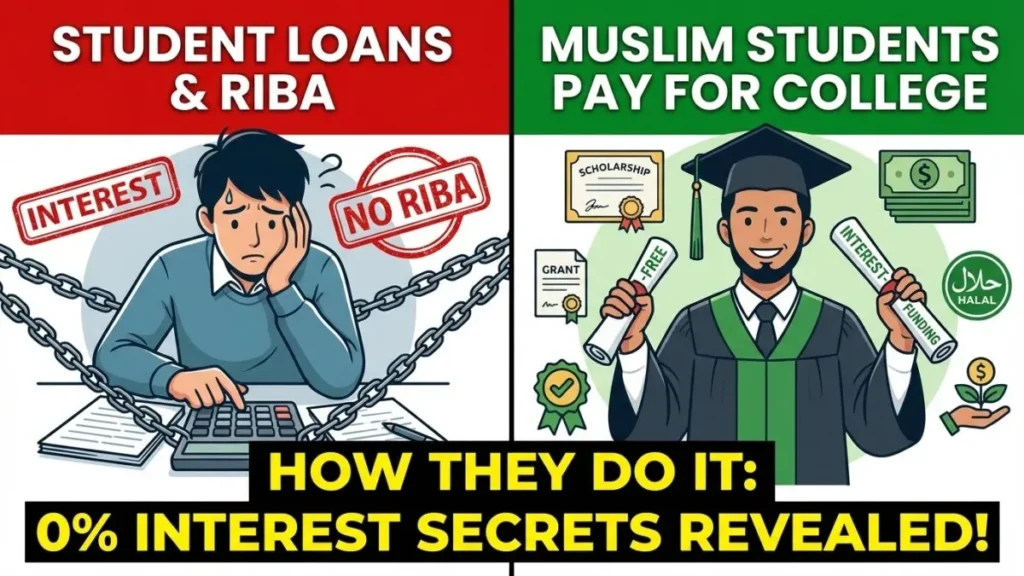
Many Muslim students face a tough choice when it comes to college. You want to get a quality education, but taking on traditional student loans feels like it goes against your beliefs. The good news? You actually have real options. There are ways to pay for college without dealing with interest (riba) at all. In this guide, I’m going to walk you through exactly how to do it—step by step, with no confusing jargon.
📌 Key Takeaways
- Interest-free loans actually exist – Organizations like A Continuous Charity offer zero-interest education loans specifically for Muslim students.
- Scholarships and grants are your first priority – These don’t need to be repaid and can cover significant portions of your costs.
- Work-study programs help you earn while you learn – You can work part-time on campus and use that income directly for tuition.
- Income share agreements are a newer option – You pay a small percentage of your future salary instead of interest.
- Community support matters – Many Muslim organizations and charities actively fund student education.
- Planning early saves thousands – Starting your search for funding sources in high school makes a huge difference.
What Does “Riba” Really Mean (And Why It Matters)
Let me be straight with you: riba is the Islamic principle against interest. When you take out a traditional student loan, you’re not just paying back what you borrowed. You’re paying extra money—sometimes tens of thousands of dollars extra—just for the privilege of borrowing.
That’s where riba comes in. You borrow $30,000, and by the time you’re done, you’ve paid $40,000 or $45,000. That extra $10,000 to $15,000? That’s riba.
For many Muslim students, paying riba creates a real moral conflict. You’re trying to better your life through education, but you feel like you’re compromising your values to do it. This shouldn’t have to be the case.
The thing I’ve noticed over years of talking with students: the moment you understand that interest-free options genuinely exist, everything changes. You stop feeling stuck. You start seeing a path forward that doesn’t force you to choose between education and your beliefs.
Why This Matters for Your Future
Here’s the reality: an average undergraduate leaves college with about $29,560 in debt. With federal loan interest rates around 6.39%, that student pays an extra $10,520 in interest alone over a 10-year repayment period.
Now multiply that across your entire career. You graduate, you’re trying to buy a car, start a business, get married, save for a house—but you’re sending money to loan companies every month. That debt follows you for a decade or more.
When you avoid interest-based borrowing, you change your entire financial future. You’re not just saving money today. You’re freeing up thousands of dollars in your 20s, 30s, and beyond.
Interest-free education financing isn’t just about ethics. It’s smart money management. It’s about giving yourself room to breathe after graduation instead of being stuck in a repayment cycle.
Step-by-Step: Your Path to Interest-Free College Funding
Step 1: Start With Scholarships and Grants (Free Money First)
I always tell students this: if you’re not hunting for scholarships, you’re leaving free money on the table.
Here’s the key difference:
- Grants = Money based on financial need. You don’t repay it.
- Scholarships = Money based on merit, background, or specific criteria. You don’t repay it.
Both are literally free. You apply, you’re selected, and the college subtracts that amount from what you owe. No interest, no loans, no repayment.
Where to look:
Start locally first. Check your:
- High school counselor’s office
- College’s financial aid website
- Local community organizations
- Your employer (if you’re working)
Then go national:
- Fastweb.com – Millions of scholarships in one searchable database
- Scholarships.com – Similar to Fastweb, very user-friendly
- Your state’s higher education agency – Many states have grants for in-state students
For Muslim students specifically, these scholarships exist right now:
- Islamic Scholarship Fund (ISF) – Offers $3,000 to $10,000 for Muslim students in law, policy, film, and media fields
- Islamic Society of North America (ISNA) Scholarships – Multiple awards for Muslim students, ranging from $500 to $2,500
- Plainfield Muslim Women for Better Society Scholarship – $1,500 for Muslim students pursuing higher education
The average scholarship takes 20 minutes to apply for. If you apply to 20 scholarships with a 25% success rate, you’re getting 5 awards. That’s potentially $25,000 right there.
Pro tip: Don’t wait until senior year of high school to start. Begin sophomore or junior year. The earlier you start, the more scholarships you can apply to, and the better your chances of stacking multiple awards together.
Step 2: Explore Interest-Free Loans Specifically
If scholarships and grants don’t cover 100% of your costs, interest-free loans are your next option.
A Continuous Charity (ACC) is the biggest one you need to know about. This is a nonprofit, run by Muslims, for Muslims. Here’s how it works:
- You apply online (usually January through March)
- You go through an interview process
- If selected, you get a loan that covers part of your tuition
- You repay only the amount you borrowed—zero interest, zero hidden fees
- You need a co-signer (usually a parent or relative)
The application process is straightforward, and they specifically created this program because they know traditional loans don’t work for Muslim students.
Other organizations offering interest-free loans:
- Bill Raskob Foundation – Up to $9,000 per year, no interest
- Evalee C. Schwarz Charitable Trust – $5,000 to $15,000 per year, lifetime cap of $60,000
- Military Officers Association of America – Interest-free loans for military families
The catch? These loans are competitive and have smaller award amounts than traditional loans. But here’s the thing: would you rather have $10,000 interest-free or $30,000 with $10,000+ in interest charges? The math is simple.
Step 3: Use Work-Study Programs
This one is underrated. Many students skip work-study because they think it means working off-campus and losing study time. Wrong.
Work-study is federal financial aid that means your college sets you up with a part-time job—usually right on campus. Common work-study jobs include:
- Working in the library
- Helping in a department office
- Working in the cafeteria
- Tutoring other students
- Administrative support
Here’s what makes it perfect for students:
- Your college limits your hours – You can’t work more than the federal limit, so you have time for classes
- The job relates to campus – No commuting, no wasted travel time
- You get paid – That paycheck goes straight to your education costs
- Work experience – You’re building a resume at the same time
Research shows that students in work-study programs actually have higher completion rates and better employment outcomes after graduation. Why? Because you’re gaining real work experience in your field while getting paid to study.
Step 4: Consider Income Share Agreements (ISAs)
Income Share Agreements are newer, but they’re worth understanding.
Here’s how an ISA works: A company or organization pays your tuition upfront. After you graduate and get a job, you pay back a small percentage of your salary for a set number of years. No interest charges, no collateral needed, no co-signer required.
Example: You get $30,000 covered by an ISA. After graduation, if your salary is $45,000 per year, you might pay 4% of your income ($1,800/year) for 7 years. If you lose your job or your income drops below a threshold, payments pause.
The advantages:
- Investors only make money if you succeed financially
- Payments are tied to your actual earning power
- No debt accumulation like traditional loans
- If you earn less, you pay less
The catch:
- Some ISAs aren’t available for all majors
- Early repayment penalties might exist
- They’re still relatively new, so fewer providers exist
- You need to understand the terms clearly before signing
ISAs work best if you’re going into a field with predictable, higher salaries (like engineering or healthcare). If you’re unsure about your post-graduation earnings, stick with scholarships and grants first.
Step 5: Reduce Costs (Live Smart, Not Poor)
Sometimes the best way to avoid borrowing is to reduce what you need to borrow.
Big cost-cutting moves:
| Strategy | Potential Savings |
|---|---|
| Start at community college, transfer after 2 years | $6,000+ per year |
| Live off-campus after first year | $3,000-$5,000 per year |
| Live with family (if possible) | $5,000-$12,000 per year |
| Use employer tuition reimbursement | Full tuition coverage |
| Take summer and winter classes | Reduce total years, reduce costs |
Let me break down community college real quick. If you take your first two years at a local community college and then transfer to a four-year university, you cut your overall cost dramatically. Same degree, way less debt.
Living off-campus is a huge saver. On-campus room and board averages $12,917 per year. An apartment off-campus with roommates? Often $7,000-$9,000. That’s real money saved.
Read more: Honest Halal Mortgage Alternatives in the USA: Guidance vs UIF vs Lariba
💡 Pro Tip: The Stacking Strategy
Here’s my best advice: don’t choose one funding source. Stack them.
Get $5,000 from scholarships. Add $3,000 from an interest-free loan. Work part-time and earn $4,000. Use community college for your first two years and save $10,000. Together, that’s $22,000 without a single interest payment.
This is how I’ve seen Muslim students successfully graduate debt-free: they combined multiple small sources instead of relying on one big loan. It takes planning, but it works.
Common Mistakes to Avoid
Mistake #1: Waiting too long to apply for scholarships
I see this constantly. Students think, “Oh, I’ll apply for scholarships in October of senior year.” By then, deadlines have passed. Start sophomore year. Seriously.
Mistake #2: Only looking at big scholarship amounts
A $500 scholarship takes 15 minutes to apply for. Do that 10 times, and you’ve got $5,000. Most students skip the small ones and only go for the big ones. Wrong strategy.
Mistake #3: Ignoring work-study
“I don’t want to work.” Okay, but do you want to pay interest? Work-study isn’t punishment. It’s financial aid that comes with a job. And it actually looks good on your resume.
Mistake #4: Not understanding loan terms before signing
If you take an interest-free loan, read the contract. Understand when you need to start repaying, what happens if you can’t pay, and what happens if the lender goes out of business. Don’t just sign because it says “interest-free.”
Mistake #5: Borrowing more than you need
Some students think, “Well, if I’m borrowing for tuition, I might as well borrow for a new laptop, a car, weekend trips.” Stop. Borrow only for actual education costs. The less you borrow, the less you repay.
Real-World Examples
Example 1: Fatima’s Approach (Community College + Work-Study)
Fatima lived with her parents and started at community college. She worked 15 hours per week in work-study at the library, earning about $250/week. Over two years, that was roughly $25,000 earned.
She got a $5,000 scholarship and took out a $3,000 interest-free loan from A Continuous Charity.
Cost after two years: She actually had a small surplus from work-study.
When she transferred to a four-year university for her last two years, she had paid zero interest, worked in a professional environment, and graduated with only $3,000 to repay (the principal of her interest-free loan).
Example 2: Ahmed’s Approach (Scholarships + ISA)
Ahmed didn’t qualify for work-study hours due to his visa status. Instead, he aggressively applied for scholarships.
He won:
- $7,000 ISF scholarship (law program)
- $3,000 ISNA scholarship
- $2,500 from his state education agency
That’s $12,500 per year. His total four-year cost was about $50,000 (after living costs). Scholarships covered $50,000 of it. For the gap, he took a small ISA for 3% of future income, paid over 5 years.
He graduated with manageable repayment and zero interest charges.
Example 3: Zainab’s Approach (Employer Support)
Zainab worked full-time as a medical assistant while getting her nursing degree part-time online. Her employer offered 100% tuition reimbursement for nursing degrees (they had a shortage of nurses).
She had to work the job to get the benefit, but she was paying as she went. Four years later: degree paid for, five years of work experience, and zero debt.
The point? All three students took different paths, but none of them paid interest.
Frequently Asked Questions
Q1: Is it really possible to graduate debt-free?
A: Yes, but it requires planning and effort. You need to combine scholarships, grants, work-study, and possibly a small interest-free loan. It’s not as common as graduating with debt, but it’s absolutely doable. I’ve seen dozens of students do it.
Q2: What if I don’t qualify for scholarships?
A: Scholarships aren’t just for top students. There are scholarships for specific majors, specific backgrounds, specific communities, and specific need levels. If you’re not winning scholarships, you’re probably not applying to the right ones. Use Fastweb to filter by your specific situation.
Q3: Can I use an interest-free loan to pay for living expenses, not just tuition?
A: Some organizations will, some won’t. A Continuous Charity typically funds tuition and mandatory fees. Some state programs cover room and board too. Check the specific organization’s terms. Work-study and part-time jobs are better for living expenses.
Q4: What if my family can’t co-sign an interest-free loan?
A: Some organizations require a co-signer, but not all. Check A Continuous Charity’s current requirements. Also explore work-study, ISAs, and scholarships—these don’t require co-signers. And ask your college’s financial aid office; they often know local nonprofits that offer small grants.
Q5: Is an Income Share Agreement better than a regular student loan?
A: ISAs are better than interest-based loans because you’re not paying interest. However, ISAs can sometimes end up costing more than the original amount if you earn a high salary. Scholarships and grants are always better. Scholarships > Interest-free loans > ISAs > Interest-based loans. In that order.
Q6: Can I work while in school without the work-study program?
A: Yes, absolutely. Many students work at local restaurants, retail stores, or businesses. The difference is that work-study is federal aid, so it’s subsidized and won’t interfere with your financial aid package. Work outside of work-study is great too, just make sure it doesn’t hurt your grades.
Q7: Are there scholarships specifically for Muslim students studying in the USA?
A: Yes! ISF (Islamic Scholarship Fund), ISNA (Islamic Society of North America), and many community organizations have scholarships specifically for Muslim students. Also check local mosques and Islamic centers—many give out scholarships you’ve never heard of.
Q8: What happens after I graduate? Do I have to start repaying an interest-free loan right away?
A: This varies. Some loans have a grace period (6 months to a year after graduation). Some start immediately. Check your loan contract. This is important—ask before you borrow so there are no surprises.
Q9: Can international students get interest-free loans?
A: This is tough. Most interest-free loans require U.S. citizenship or permanent residency. International students have fewer options. Look into Prodigy Finance (no collateral, no co-signer required) or see if your university has specific programs for international students.
Q10: How do I know which organization is legitimate and not a scam?
A: Check if they’re registered 501(c)(3) nonprofits. Look for independent reviews online. Ask your college’s financial aid office if they know the organization. Never pay an upfront fee for a scholarship or loan application. Legitimate organizations don’t charge you to give you money.
Your Action Plan: Start Today
You don’t need to have all this figured out right now. You need a plan.
If you’re in high school (9th-11th grade):
- Start building your scholarship list using Fastweb or Scholarships.com
- Ask your counselor about local scholarships
- Get good grades (scholarships love a solid GPA)
- Join one community organization or volunteer activity
- Start applying for scholarships in October (not May)
If you’re in your senior year:
- Fill out the FAFSA (Free Application for Federal Student Aid) – yes, even if you don’t want federal loans, you need this
- Apply to at least 20 scholarships (seriously, 20)
- Ask your college about work-study programs
- Research A Continuous Charity and other interest-free loan organizations
- Look into ISAs if scholarships don’t fully cover costs
If you’re already in college and using loans:
- See if your college has an interest-free loan program
- Check if you qualify for work-study now (if you don’t already)
- Hunt for scholarships for your remaining years (yes, they exist for current students too)
- Calculate exactly how much interest you’re paying—this might motivate you to find alternatives
If you’re supporting younger siblings:
- Share this article with them
- Help them start the scholarship search early
- Explain why work-study matters
- Let them know interest-free options exist
Final Word: You Have More Options Than You Think
Here’s what I want you to take away from this: paying for college without interest isn’t a miracle. It’s not impossible. It’s just less common because most people don’t know it exists.
Thousands of Muslim students graduate every year without paying a cent in interest. They did it by combining scholarships, work-study, interest-free loans, smart cost-cutting, and sometimes ISAs.
You can be next.
The hardest part is starting. That’s it. Once you start applying for scholarships and researching organizations like A Continuous Charity, momentum builds. You win one scholarship, then two, then three. You work a part-time job and realize you’re earning money while gaining experience. You find an interest-free loan that covers the gap.
Within a year, you’ve got a real plan.
So here’s my challenge for you: This week, go do one thing. Log into Fastweb. Call your college’s financial aid office. Ask your local mosque if they have education funding. Apply for one scholarship.







1 thought on “Student Loans & Riba The Essential Guide to Halal College Funding for Muslim Students”