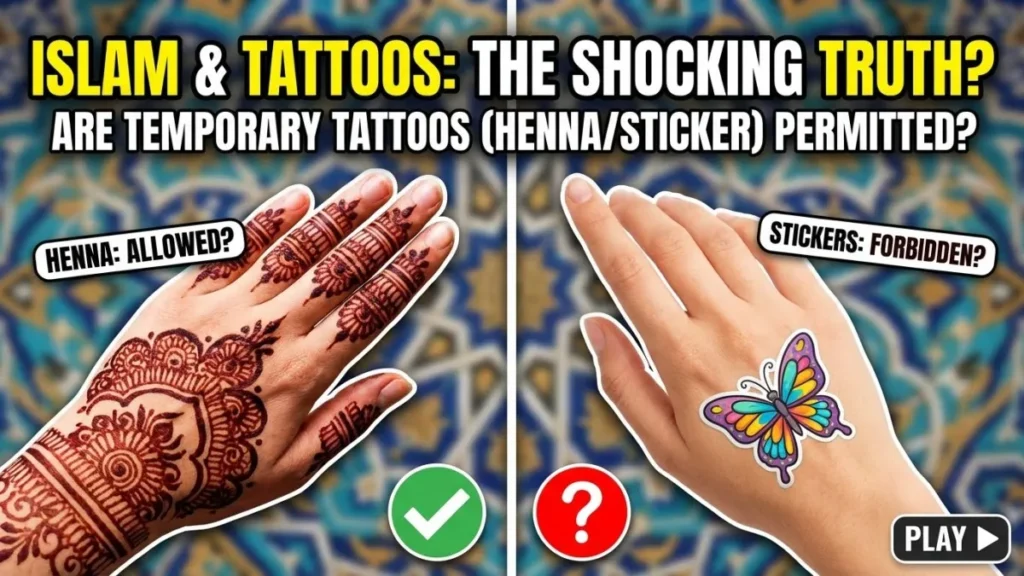
Temporary tattoos like natural henna are generally allowed in Islam if they don’t block water during ablution and contain pure ingredients. Sticker tattoos are permitted in specific areas and conditions. Permanent tattoos remain forbidden. The key difference? Temporary doesn’t alter your body permanently—permanent ones do.
Key Takeaways
- Natural henna (mehndi) is encouraged, especially for women during celebrations
- Black henna with chemicals (PPD) should be avoided—it can harm your skin
- Sticker tattoos are permissible if they don’t prevent water from reaching your skin during ablution
- Design matters: Avoid designs with living creatures or offensive symbols
- Permanent tattoos remain forbidden based on Islamic teachings
- Intent and placement determine what’s acceptable and what isn’t
What This Topic Means: Understanding Temporary vs. Permanent
Before we dive deeper, let’s get clear on what we’re actually talking about.
Permanent tattoos are ink injected deep into your skin using needles. They stay with you for life. Temporary tattoos come in three types: natural henna (mehndi), sticker tattoos, and synthetic henna. These wash off or fade within days or weeks.
The Islamic concern with any tattoo has always been about permanently changing your body. Your body is a trust from God. Permanently altering it without medical need is seen as disrespectful to that trust. But temporary solutions? That’s a different story.
Think of it this way: a sticker you can peel off in two days is not the same as a needle mark that stays for life.
Why This Matters: Benefits and Importance
Understanding the ruling on temporary tattoos affects your daily life, worship, and celebrations.
Why it matters for Muslims in Western countries: You live in diverse communities where body art is common. You need clear answers about what’s acceptable so you can make informed choices. Many of you attend weddings, Eid celebrations, and social events where henna is applied. You want to know: Can I get henna without concerns? Will my ablution be valid?
Impact on celebrations: Henna (mehndi) is a cultural and spiritual celebration in Islamic traditions. At weddings, Eid, and family gatherings, women apply henna to their hands and feet. This practice comes with positive memories and tradition. Knowing it’s permitted lets you celebrate freely.
Impact on prayer validity: One major concern is whether a temporary tattoo blocks water during ablution (wudu). If water can’t reach your skin, your ablution is invalid. Your prayers won’t count. So understanding this directly affects your spiritual practice.
Practical peace of mind: Instead of worrying, you’ll know exactly what’s allowed and why.
Step-by-Step Breakdown: The Complete Guide
Step 1: Know the Difference Between Henna Types
Not all henna is the same. This is crucial.
Natural Henna (Brown Henna)
- Made from: Powdered leaves of the henna plant only
- Color: Reddish-brown
- Lasts: 1-3 weeks (fades naturally)
- Ingredients you’ll see: Henna powder, lemon juice, essential oils (like lavender), sugar
- Safety: 100% safe for all skin types
- Islamic ruling: Permitted and encouraged
Black Henna (Chemical Henna)
- Made from: Henna + a chemical called PPD (paraphenylenediamine)
- Color: Jet black, appears instantly
- Lasts: 1-2 weeks but can cause skin damage
- Ingredients: PPD is the dangerous part—it’s the same chemical in some hair dyes
- Safety: Can cause burns, rashes, scarring, and allergic reactions
- Islamic ruling: Avoid it
Pro Tip: When someone offers you henna, ask these questions: (1) Is it natural henna? (2) What are the ingredients? (3) Does it smell earthy or chemical? Natural henna smells like crushed leaves. Chemical henna smells synthetic or has no smell at all.
Step 2: Check If the Design Is Acceptable
The design matters just as much as the material.
Designs that are ALLOWED:
- Geometric patterns (squares, diamonds, lines)
- Floral designs (flowers, leaves, vines)
- Arabic calligraphy of Quranic verses
- Abstract designs
- Henna on hands, feet, legs, or arms
Designs that are NOT allowed:
- Images of living creatures (animals, birds, humans, faces)
- Symbols of other religions
- Anything offensive or disrespectful
- Any design that violates modesty (satr)
Why? Islamic teaching discourages the depiction of living creatures. But henna has existed in Islamic cultures for centuries, so scholars made an exception for traditional, decorative patterns.
Step 3: Verify the Placement
Where you put your temporary tattoo affects whether it’s acceptable.
Safe placements (won’t affect ablution):
- Hands (all parts)
- Feet (all parts)
- Legs
- Arms
- Back
- Neck
Areas that require careful consideration:
- Face (must not violate modesty rules when going in public)
- Chest (covered areas are fine)
- Any area you plan to display in front of non-related men
Why? Islam teaches modesty. If you’re in a Western country with less strict dress codes, this is less of an issue. But consider your intentions: Are you beautifying yourself for a spouse? For celebration? Or to draw attention from others?
Step 4: Perform the Water Test (For Sticker Tattoos)
This is critical. A sticker tattoo that blocks water invalidates your ablution.
How to test:
- Apply the sticker tattoo on a small area
- Pour water over it
- Does water bead up and stay on top? Problem
- Does water flow through naturally? Good to go
Why it matters: During ablution, you wash specific body parts. If a temporary tattoo sits on top of your skin like a plastic barrier, water can’t reach the skin beneath. This breaks the rules of ablution. Your prayers won’t be accepted until it washes off.
The key principle: If it’s merely a color that washes away with water (like natural henna), it’s fine. If it’s a physical barrier (like most sticker tattoos), it’s problematic for prayer areas.
Step 5: Check Ingredients and Materials
Before getting any temporary tattoo, verify what’s actually going on your skin.
Natural henna ingredients (safe):
- Henna powder (lawsonia inermis plant)
- Lemon juice or water
- Essential oils (cinnamon, eucalyptus, lavender)
- Sugar
Sticker tattoo materials (often safe, but check):
- Paper-based transfer
- Water-soluble inks
- Skin-safe adhesives
Things to avoid:
- PPD (paraphenylenediamine)—this is in black henna
- Alcohol content (some temporary tattoo inks contain alcohol, which is problematic for some scholars)
- Non-halal animal by-products
- Synthetic dyes with unknown origins
Pro Tip: Buy henna from reputable sellers. If you’re in a Western country, look for sellers in Middle Eastern, South Asian, or Indian communities. Ask for “100% natural henna” or “BAQ henna” (Body Art Quality).
Read more: 7 Shocking Truths: Why Men Wearing Gold or Silk Is Forbidden in Islam (Science Explained)
Expert Tips and Best Practices
1. Timing matters: If you get henna right before prayer, make sure it’s completely dry. Wet henna might block water. Let it dry for 12-24 hours, then the color is set and you can perform ablution freely.
2. For special events: Many women get henna for Eid, weddings, or Ramadan. This is not just permitted—it’s encouraged. It’s a sign of celebration and joy. The Prophet’s wife, Aisha, used henna, and scholars recommend it for women.
3. Men and henna: Men can apply henna to their beards to darken grey hair. The Prophet himself used henna for this. However, men should not use henna for pure beautification like women do—this would be imitating women, which is discouraged.
4. For sticker tattoos in public: Be mindful of how they’re perceived. In Western countries, temporary tattoos might not raise eyebrows. But remember: Islam values modesty and avoiding suspicion. If a temporary tattoo on your arm makes people assume you have permanent tattoos (which are forbidden), reconsider.
5. For prayer areas: If you’re applying a sticker tattoo to your forearms, wrists, or feet (areas you wash during ablution), test it first. Choose brands that don’t block water.
6. Cost and quality: Don’t cheap out. Low-quality temporary tattoos often contain harmful chemicals and definitely block water. A good henna application from a professional lasts longer, looks better, and is safer.
Common Mistakes to Avoid
Mistake 1: Assuming all henna is the same
Not all henna sellers are honest. Black henna is marketed as “darker henna” when it’s actually a chemical mixture. You buy it, apply it, and then your skin reacts badly. Always ask questions and read labels.
Mistake 2: Not testing before prayer
You apply a sticker tattoo the day before Jummah (Friday prayer). During ablution, water doesn’t reach your skin. Your wudu is invalid. You can’t pray. Don’t let this happen—test first.
Mistake 3: Getting henna on areas that affect ablution without checking
Some henna artists apply henna to areas that will be washed during ablution. If it sits on top like a barrier, it’s a problem. Know your ablution areas: hands, face, arms, feet, and head.
Mistake 4: Not considering intent
Why are you getting a temporary tattoo? If it’s purely for vanity or to attract attention from non-related people, that’s different from celebrating at a wedding or Eid. Your intent matters in Islam.
Mistake 5: Mixing sticker tattoos with prayers
You got a sticker tattoo on Monday. It doesn’t wash off easily. Wednesday comes, and you realize it’s blocking water. You can’t pray properly until it’s gone. Plan ahead.
Mistake 6: Choosing unknown sellers
You find a “henna artist” at a street fair who uses black henna. Three days later, you have an allergic reaction—burns, rashes, scarring. Stick to trusted sources.
Real Examples: Scenarios Explained Simply
Example 1: The Wedding Henna
Scenario: Fatima is getting married next month. At her mehndi ceremony (henna night), women gather to apply henna on her hands and feet. The henna is natural, reddish-brown, from a trusted seller. The designs are traditional floral patterns with no living creatures. She applies it 24 hours before her wedding, giving it time to set.
What happens: The henna dries and becomes part of the skin’s color. Water still reaches the skin underneath. She performs her ablution normally before her wedding prayers. Everything is valid.
Why it’s allowed: (1) Natural henna, (2) Traditional designs, (3) Proper placement, (4) Intent is celebration and femininity, not vanity.
Example 2: The Sticker Tattoo Problem
Scenario: Ahmed buys a sticker tattoo at a shopping mall. It’s a cool design. He applies it to his wrist on Friday morning before Jummah. He forgets to test whether water passes through.
What happens: At the mosque, during ablution, water beads up on the sticker. It doesn’t reach his skin. He’s unsure if his ablution is valid. He feels anxious during prayer because he doesn’t know if God accepted it.
Why it’s a problem: The sticker acted as a barrier. His ablution was technically invalid because water didn’t reach the washed areas.
Solution: Remove the sticker before prayer. Or next time, test it beforehand on a small area. Choose tattoos that let water through or apply them to areas not washed during ablution (like your upper arm or leg).
Example 3: The Black Henna Reaction
Scenario: Aisha goes to a fair where someone offers “super dark henna that lasts 2 weeks.” It’s actually black henna with PPD. She applies it to her hands for a party.
What happens: Within hours, her hands start itching. By next morning, she has red welts and blisters. She visits a doctor who explains it’s an allergic reaction to PPD. The burns take weeks to heal and leave scars.
Why it happened: Black henna is not real henna. PPD is a dangerous chemical. Just because something is called “henna” doesn’t mean it’s safe.
Prevention: Always ask for the ingredients. Buy from reputable sources, not random vendors.
Example 4: The Hanafi Scholar’s Guidance
Scenario: A young Muslim from a Hanafi background (the most followed school of Islamic law in South Asia) asks a local imam about whether she can apply henna before Ramadan.
What the Darul Uloom Deoband (the main Hanafi institution) says: Henna dyeing is proven from hadith. It’s allowed for women. Natural henna is reddish-brown, and that’s fine. If it’s truly black henna (with chemicals), it’s unlawful because the chemicals are harmful and it imitates forbidden practices.
Result: She gets natural henna. It’s allowed and encouraged.
FAQ Section: Your Questions Answered
1. Is henna allowed in Islam for women?
Yes. The Prophet Muhammad (peace be upon him) and his wives used henna. Scholars actively recommend it for women as a form of beautification and femininity. It’s especially encouraged during celebrations like Eid and weddings. Natural henna is fully permissible.
2. Can men use henna?
Men can use henna specifically to darken their beards and hair, which is recommended in Islamic teaching. However, men should not use henna purely for beautification like women do, as this would imitate women. Medical or practical uses are fine.
3. Will a temporary tattoo invalidate my ablution?
It depends on whether it blocks water. If it’s natural henna (just a color), water reaches your skin—ablution is valid. If it’s a sticker tattoo that forms a physical barrier, water can’t reach—ablution is invalid until it’s removed. This is why testing matters.
4. Is black henna allowed?
No. Black henna contains PPD, a dangerous chemical. It’s not real henna. Avoid it completely. The Darul Uloom Deoband explicitly states that black henna with chemical dyes is unlawful.
5. What if I have a permanent tattoo from before I became Muslim or before I understood the ruling?
You’re not sinful for having it. The sin was in the act of getting it. Now that you know it’s forbidden, repent, and don’t get more. The permanent tattoo doesn’t invalidate your ablution or prayer because the ink is under your skin, not on top. You can pray normally. Some scholars recommend removing it if possible, but if it’s difficult or expensive, it’s not mandatory.
6. Can I get a temporary tattoo on my face?
Technically, yes. But consider Islamic teachings on modesty. If displaying a face tattoo would draw unwanted attention or violate your values, avoid it. In Western countries, this is less of an issue than in traditional Muslim communities. Use your judgment and intention.
7. Are sticker tattoos from stores safe?
Most are safe for skin. The main concern is whether they block water during ablution. Read the product details. Test it before using it near prayer times. Choose reputable brands. Avoid unknown sellers at fairs or streets.
8. What if I want a tattoo of a Quranic verse in Arabic?
This is permissible. Islamic calligraphy is considered art, not living creature depiction. You can get this as a temporary tattoo (henna or sticker) without issue. Permanent tattoos of Quranic verses are debated—some scholars say it’s disrespectful to have holy words on your skin where you might sweat or sit on them. Use henna or stickers instead.
9. Can I get henna during Ramadan?
Yes. Henna doesn’t break your fast. It’s not food or drink. You can apply it anytime, including during Ramadan. Many women get henna during Ramadan or just before Eid.
10. How long does natural henna last?
1-3 weeks. It depends on how much you wash your hands and the quality of the henna. Higher-quality, natural henna from experienced artists lasts longer. Over time, it fades to a lighter orange-brown before disappearing completely.
Final Conclusion: What You Should Do Now
Here’s the bottom line: Temporary tattoos are allowed in Islam if you follow the key rules.
Your Action Plan:
1. Choose natural henna for celebrations
- Get it from a trusted source in your community
- Ask for 100% natural henna or BAQ henna
- Avoid anything labeled “black henna”
2. For sticker tattoos, test first
- Apply a small piece to check if water passes through
- If water blocks, remove it before prayer times
- Choose brands from reputable stores
3. Check the design
- No living creatures or offensive symbols
- Geometric, floral, or calligraphy are all fine
4. Remember your intent
- Are you celebrating or beautifying yourself appropriately?
- Is this in line with Islamic values of modesty and respect for your body?
5. Plan around prayer
- If applying henna before prayer, let it dry completely first
- If applying a sticker to prayer areas, ensure water can pass through